Novos Fimes do Cine HD
Showing posts with label art and design. Show all posts

"Freedom from Want": Thanksgiving and grandmothers

-
-

What I want is not the turkey on the platter, which seems too big for the spot where Grandma is placing it. And how is she carrying it anyway? My weak wrists would never make it, and the turkey would crash onto the floor. I’d let Grandpa carry it and smile sweetly, basking in the oohs and ahs.

What I want is Grandma herself. And Grandpa. How kind and cuddly they look.

The song associated with Thanksgiving is “Over the River and Through the Woods” which continues with “. . . to Grandmother’s house we go.” I never did such a thing. The only time I went to a grandparent’s house was at the time of Grandma Olive’s death and funeral, in Bayonne, New Jersey, when I was four. I played with toy cars in the steep driveway of my grandmother’s home on the bay. That’s what I remember.

When childhood friends said their grandma died, I thought, big deal. I had no heart pocket for such a relationship.

Grandpa Reuben is the only grandparent I remember, and he was not my mom’s biological dad. He was Grandma Olive’s second husband, who happened to be the cousin of her first, my mom’s dad Sidney. Olive didn’t have to change her last name when she married Reuben. I met Grandpa Reuben twice and was in love with him, the way a girl is in love with her grandpa. He was posh in suits but intensely kind.

Is there a word for being a grandchild orphan?

It is an odd and empty feeling not to have met my grandparents. But it is even odder now to contemplate that my grandparents did not meet all of their grandchildren. Dad’s dad was 70 when he was born; he fought in the Civil War in 1865; he died when Dad was 9. Dad’s mom died in the ‘50s before I was born, the last of eight kids. Mom’s biological dad Sidney was divorced from Grandma Olive and far away when we kids came along. Grandma Olive died when I was four; maybe she held me, I don’t remember. Then there was Grandpa Reuben, a fine substitute, but once on his jostling knees and once after his stroke in a wheelchair is it for memories.

Now, I’m going to be a grandma. When I first found out our daughter was pregnant, I thought I would need advice for my new role, since I had no grandparent memories to speak of. But guess what, there seems to be a heart pocket (think cargo pants) for this relationship after all. Strangely enough, while I’m loving my unborn grandson, it's almost like I'm sitting on my own lap, feeling loved.


Note about the painting: "Freedom from Want" was one of four "propaganda" posters by Norman Rockwell inspired by Theodore Roosevelt's speech to Congress January 6, 1941, urging the country to enter World War II. Read more here.
-
-
Contas Premium

Bedlam: A fresh look at an old horror

-
-
I am interested in how openly we share intimate stories of cancer, lupus, stroke, heart attack, and other physical maladies, but we are still fenced in about mental illness. Even Alzheimer’s is all right to discuss: it is a physical disease. But when it comes to mental disease, we hesitate to talk about disorders within our families, let alone personal struggles, feeling stigmatized by the mere association.

The days are still too close when people paid money to see the freak show: not bearded ladies, giants, Siamese twins or Elephant Men, but the insane. The wards of the infamous Bedlam asylum were salons for gawking, where fine ladies came to be entertained by raving lunatics.


Tom Rakewell ends up in Bedlam after a profligate life;
one painting in a series of paintings and engravings 
by William Hogarth called "The Rake's Progress"


Bedlam, now Bethlem Royal Hospital, is known as the oldest institution for mental patients (1247) and is notorious for its tortuous and dastardly treatment of patients. Remarkably, now it is a major center for research that promotes the best and most humane psychiatric practice and care. (See the history of Bedlam here.) But the word bedlam will always mean the uproar and chaos exemplified in that madhouse.

Eerily and perfectly timed for the end of Halloween week, two friends of mine have just opened an art exhibit of their Bedlam project. Robert Turney is an art photographer in the media of gelatin silver prints and wet-plate tintypes. (He happens also to be married to my professor, mentor and friend, Diane Wakoski.) Stephen Rachman is an American Studies scholar and chair of graduate studies in my department.

I really love Robert's photographs. Here is a sampling of his previous work, in gelatin silver prints.

Robert's gelatin silver prints


Rio Chama, New Mexico

Shack and Seatless Chair
Goldfield, Nevada

 New York #5

New York #9


New York #10


Robert's wet plate tintypes

And here is a sampling of Robert's more recent work, wet plate tintypes. To watch a stop motion video of Robert developing wet-plate collodian tintypes, twenty minutes shortened to two minutes, go here.


You know I love these two still lifes:


Moonflowers

Previously Robert and Steve collaborated on a subject happier than Bedlam: moonflowers. Robert created 10 x 10 inch gelatin silver photographs, shooting the moonflowers he grew potted in his wonderful town garden, at night. (Robert's garden is famous for certain rows of basil that went into Diane's legendary pesto with twenty-five, yes 25, cloves of garlic, that I ate with abandon, and after which Don would not sleep in the same room with me.)  Of course Robert photographed them at night, when they open. Robert's evening dance in his driveway with lights, medium format camera and moonflowers is enough to send a poet off for a week's contemplation, but combine it with Steve's gorgeous essay "Evening Glories," published with images of Robert's gelatin silver prints in the Red Cedar Review, and I am truly inspired. Below are a couple of Robert's gelatin silver moonflowers and excerpts from Steve's essay; see the twelve piece portfolio here. Read Steve's essay about Robert's moonflowers called "Evening Glories: Robert Turney's Moonflower Photographs" here:

"From 1999-2001, in this seasonal way, Turney pursued the flowers, under clouds, under stars, under the glowing coal of his cigarette. . . . It would be easy to misconstrue Turney’s moonflowers as conventionally romantic. . . . If they are romantic at all then they refer to the romance of ordinary beauty, sensuality, and sex. . . . "

~ excerpt from Steve Rachman's essay "Evening Glories"

Two of Robert Turney's gelatin silver prints of moonflowers:


"One secret of the moonflower photos lies in that Turney has photographed flowers as if they were movie stars from the 1930s and 40s. Think of Marlene Dietrich, Greta Garbo, and Martha Graham rendered by Edward Steichen . . ."    ~ Stephen Rachman, from "Evening Glories"


Bedlam

So what led these two to another textual and photographic partnership, this time about the insane asylum? Robert got to talking about the tintype self portraits he was developing, and Steve began to imagine a fiction about a psychiatrist and a patient, with tintype photography as therapy! The gallery show has single rows of tintype portraits of the patient (Robert himself, acting as G.G.), separated by text written by Steve: imagined journal entries by the psychiatric doctor about his patient G.G. He brings the patient into his studio, observes him under the lens, and sees an improvement in his demeanor. As you progress around the room, the patient in the portraits evolves from a state of violent agitation to calm melancholy.


A sampling of Robert's self portraits, as asylum patient G.G., with some of Steve's journal text,
progressing from extreme agitation to almost beatific calm:


"G.G. converses rationally on most subjects often with amiable feeling and charming manners; and yet he is incapable of going among people without severe mental agitation and reflection. G. G. exhibits great terror and excitement at the prospect of crowds."


". . . And this, it occurred to me, might in the end be what the camera reveals: I have always been struck by this phenomenon in cases of insanity. The insane pose for the sane in postures of madness—or feigned sanity—much as we pose for the camera."


(This one, above, is my favorite of Robert's tintypes;
it moves me in ways I cannot describe.)


Here are two fascinating pages of Stephen's text, which are especially interesting to me, in light of our discussions about translation and poetry at the Rilke blog. I hope you can read my images of them:


I asked Robert if he found himself in any emotional distress while photographing himself as Bedlam patient G.G. "No," he said. "I just made faces." And he asked if I knew the work of Sally Mann, who photographed her children, at home, in intimate poses, sometimes naked. Yes, I did. He said, "She is the only one who could take those photographs, they are her children, in her rural home." He said that these self portraits are like that. He was not exploiting a patient in a mental hospital. He was imagining himself as one, yet thankfully (?) with emotional distance.

For me, through Robert's faces I felt the pain of mental disease, and the terrible history of ostracism and stigma surrounding it. Yet I did not feel disturbed the way I anticipated feeling at Robert and Stephen's exhibit, linking to the ghosts in my own family's history, like that shadowy hand mysteriously moving between candlesticks in Robert's tintype, above. These were after all imagined portraits and journal entries. (Before attending the show, I thought Stephen had discovered real Bedlam documents.) There was jaunty jazz playing in the background. Stephen's fictional journal entries reflected sometimes humorous aspects of the patient's world, stepping over the sacred line of treating mental illness in only morose and somber terms. This kind of open exploration and artistic imagining can help us bust down fences about the ways we may feel threatened by the topic of mental disabilities.

But no matter how painful the topic—and reality—remains, we will still have the tender melancholy of moonflowers for comfort. In the end, perhaps it is only a full frontal look at ourselves, that includes our dark shadow side, that will heal us and make us whole.

"There is one that Turney doesn’t particularly care for (because the blossom appears more like a pansy than a moonflower) but might just as easily serve as an emblem of the study. It consists of a full frontal blossom. It is the moon almost full but for a petal edge bending into a deep shadow, the moon become a flower, a flower become the moon."    ~ Stephen Rachman, from "Morning Glories"


Robert Turney and Stephen Rachman,
Bedlam art exhibit at Scene Metrospace in East Lansing, Michigan
The show opened Friday and will run until December 11.

I hope you'll forgive me for going on a little longer in an already too-long post for a blog. While I stood before one journal entry at the exhibit, in dialog with my friend Reade about my findings in the bits of research I'd done on Bedlam and how people paid money to see patients writhe in torment, I told her about William Hogarth's painting "A Rake's Progress" at the top of the post. She then told me about the opera by Igor Stravinsky (libretto by lifelong friends and collaborators, the poets W. H. Auden and Chester Kallman) of the same name, based loosely on Hogarth's paintings and engravings of Tom Rakewell whose dissolute life led to the poorhouse, and then to Bedlam. Here is another imagined Bedlam story, in which Tom cavorts in London with a bad sort of fellow, Nick Shadow, who turns out to be the Devil. It is a moralistic tale, and Rakewell ends up in Bedlam, affirming the belief held by some that "For idle hearts and hands and minds the Devil finds a work to do." Dawn Upshaw sings a lullaby, "Gently, Little Boat" as Anne Trulove, Tom's betrothed, in this touching scene toward the end of the opera.


I'm grateful that psychiatrists like James Hillman, who continued the work of Carl Jung, have encouraged us to stop moralizing about our dark side, denying or rejecting our shadow selves. I want to keep that open and eager spirit alive and working, to gently love the shadows in myself and in others, or as Hillman puts it, to see generously:

Shadow is the very stuff of the soul, the interior darkness that pulls downward out of life and keeps one in relentless connection with the underworld. . . . the shadow may be reconceived. (James Hillman, The Dream and the Underworld)


. . . you find your genius by looking in the mirror of your life. Your visible image shows your inner truth, so when you're estimating others, what you see is what you get. It therefore becomes critically important to see generously, or you will get only what you see; to see sharply, so that you discern the mix of traits rather than a generalized lump; and to see deeply into dark shadows, or else you will be deceived.” (James Hillman, The Soul’s Code)
-
-
-
Contas Premium

Tesselating

-
-

Our days run on in mundane, ordinary echoes of each other.
But think of honey from the tessellations of a honeycomb.
Consider the patient migration of a turtle in his symmetrical coat of arms.
What warm energy pushes within facsimiles and repetitions?
And what do their tiled borderings make possible,
like the scales of a snake’s skin that enable him
to undulate like an S of smoke sideways across the grass?


Eaglehawk Neck in Tasmania
one of the rare natural tesselations on the earth's surface;
see what natural movement formed it here.
Photo wiki commons

Drawings of symmetry by M.C. Escher; more here.


Contas Premium

The Willow Ball!

-
-

As Winter gets ready to hook her come-hither finger around the neck of the sun, our inner rooms begin to come alive with the warm glow of lamps, candles, a fireplace or wood stove, and a samovar for tea. It can only mean that the holidays are coming, and to start the season off properly, the Lady of Willow Manor shall throw her annual ball where everyone is welcome, no one excluded. With our bloggy imaginations we can publish fantasies right here with our fingers, choosing our dream escort and rich attire to adorn our perfect bodies. We are able to dance like gods and goddesses all cyber-night long. Maybe every girl who dreams of her someday-wedding gown at age five is really just dreaming of a ball. Which of us dreamed of anything as elegant (and sizzingly fun!) as Willow's Ball? And guess what, it's on the night of the full moon. With or without a full moon, no matter how perfectly envisioned and planned, things can go wildly out of control; you would not believe the stories from years gone by! Half the fun is reading reports of goings-on in the comments at Willow's blog the night of the ball! (Last year's here.) The ball is tomorrow, there's still time to gather your accoutrements and wits. Your invitation is here; Tess will have a Mr. Linky up in the next 24 hours or so. I didn't think I was in the mood for a ball, and here I am going on and on!

Update: Willow has declared the ball open, there are already acres of cars parked and terabytes of blogs to visit. The festivities are here!


I chose the white lace dress with yellow trims by James Tissot, at top. The whole scene is evocative, and although the painting is titled The Gallery of HMS Calcutta (Portsmouth), some call it Remembrance of an Onboard Ball. A ball on a small ship? Wow. The dress looks good from this side, I think, the side you see on the dance floor.

As for who will go with me, I don't plan on taking a chaperone, as in Tissot's painting. Just a man.

I learned last year, with my fine escort Fitzwilliam Darcy, that a dreamily handsome and charming date is not necessarily the best choice. I barely got one dance with him. He was popular even with the men! Quite a change from the snob who turned his nose up at dancing in certain ballrooms. But he had lost his pride, and anyway he could see that at Willow's Ball, everyone is a fine dance partner.

Because Leo Tolstoy has been my close companion for over a year (I hold him affectionately in my hands: War and Peace), after fingering through potential escorts in my heart's little black book, I realized he would be the perfect partner for the ball. After he picks me up in his skiff and we bob up river to the Manor, he will settle in with a book in a nook. (I offered him my Kindle—not Nook—to re-read W and P, but he said he's more interested in Rilke's letters from Russia.)

Tolstoy is not one for balls, despite his noble upbringing. But his choice of an ascetic life, he assures me, will not cause him undue discomfort in the presence of so much frivolous ruffle and draped satin. He craves the music. He is well on in years, and tired, so he will sit and listen, or read, while I dance the night away with whomever I wish. When I am fagged from waltzes and fox trots and need a few moments' rest, he will be waiting in his radiant corner to captivate me in conversation. Don’t worry about him being bored and neglected. See how he holds the chair open next to him? You too can sit and carry on discourse with Monsieur Tolstoy when you need a rest. I will concede this so long as I can cut in. I doubt very much that the chair will be empty for long, as we will all need a rest now and then, and hushed dialog about many things. (I want to tell him, for instance, what came of his epistolary acquaintance with Mohandas Gandhi a few decades after they corresponded for a year about nonviolent resistance until the end of his life in 1910.) At Tess’s Willow Ball, all things are possible, because while Monsieur Tolstoy speaks Russian and French, and I don't, we will magically understand one another.


Notes about the paintings:

The Gallery of HMS Calcutta (Portsmouth), circa 1876, sometimes called Remembrance of an Onboard Ball, by James Tissot, Tate collection

"Tissot often painted a man with two women in order to explore the subtle nuances of flirtation and attraction through body language and facial expression. Here a chaperone separates the young naval officer from the object of his attentions, the woman hiding her enjoyment of his flirtation behind her fan. Tissot focuses here on the boundaries of Victorian propriety and social convention, and their transgression. The languid pose of the nearest woman, and Tissot’s frank concentration on her fashionable hour-glass figure, inevitably led to the picture being criticised when it was first exhibited. The author Henry James dismissed it as ‘hard, vulgar and banal’." (From the display caption August 2004)

Leo Tolstoy, by Leonid Pasternak

This painting of my companion was done by Leonid Pasternak, father of the poet and novelist Boris Pasternak, best known for his novel Doctor Zhivago. Pasternak was a friend of Tolstoy's and painted illustrations for Tolstoy's novels. More info about Pasternak in a short bit I wrote for the Rilke blog here.

André Rieu is rehearsing Shostakovich's Russian Waltz for tomorrow night!


-
-
Contas Premium

Lessons and inspiration for a grandma-in-waiting

-
-


"In January it will be so nice while slipping on the sliding ice to sip hot chicken soup with rice . . . " (when I hold my brand new grandson). "Sipping once, sipping twice, sipping chicken soup with rice." (Maurice Sendak, Chicken Soup with Rice: A Book of Months)


"Grown-ups never understand anything by themselves, and it is tiresome for children to be always and forever explaining things to them." (Antoine de Saint-Exupéry, The Little Prince)


"Granny, what was it like when Mummy was me?" (Tasha Tudor, A Time to Keep: A Book of Holidays; this illustration is not from that book, and I'm sorry I don't know which it is from.)


“When the first baby laughed for the first time, its laugh broke into a thousand pieces, and they all went skipping about, and that was the beginning of fairies.” (J. M. Barrie, Peter Pan, Arthur Rackham, illustrator)

"Well, please, North Wind, you are so beautiful, I am quite ready to go with you."

"You must not be ready to go with everything beautiful all at once, Diamond."

"But what's beautiful can't be bad. You're not bad, North Wind?"

"No; I'm not bad. But sometimes beautiful things grow bad by doing bad, and it takes some time for their badness to spoil their beauty. So little boys may be mistaken if they go after things because they are beautiful."

"Well, I will go with you because you are beautiful and good, too."

"Ah, but there's another thing, Diamond:—What if I should look ugly without being bad—look ugly myself because I am making ugly things beautiful?—What then?"

"I don't quite understand you, North Wind. You tell me what then."

"Well, I will tell you. If you see me with my face all black, don't be frightened. If you see me flapping wings like a bat's, as big as the whole sky, don't be frightened. If you hear me raging ten times worse than Mrs. Bill, the blacksmith's wife—even if you see me looking in at people's windows like Mrs. Eve Dropper, the gardener's wife—you must believe that I am doing my work. Nay, Diamond, if I change into a serpent or a tiger, you must not let go your hold of me, for my hand will never change in yours if you keep a good hold. If you keep a hold, you will know who I am all the time, even when you look at me and can't see me the least like the North Wind. I may look something very awful. Do you understand?"

"Quite well," said little Diamond.

(George McDonald, At the Back of the North Wind, Arthur Hughes, illustrator)


"But Peter, who was very naughty, ran straight away to Mr. McGregor's garden and squeezed under the gate!" (Beatrix Potter, The Tale of Peter Rabbit)


“Promise me you'll always remember: You're braver than you believe, and stronger than you seem, and smarter than you think." (Christopher Robin, to Winnie the Pooh, A. A. Milne, E. H. Shepard, illustrator)


Peter Spier, Rain.


-
-
Contas Premium

Music lessons for Rumi's birthday

-
-

Trade your cleverness for abandonment. 
~ Rumi

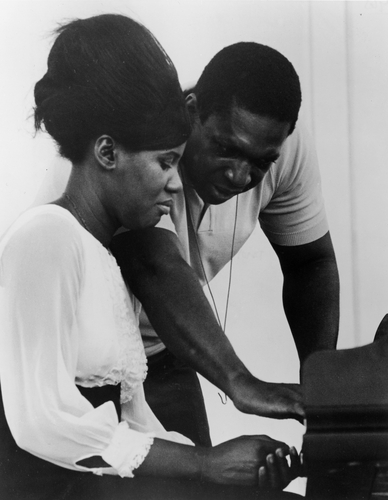
Frederick Leighton’s painting of a music lesson (see note below), perhaps between mother and daughter, and the photograph below of John Coltrane giving piano tips to his wife Alice, offer a pretty, demure picture of music lessons. I am here to tell you that taking piano lessons from my mother was, at times, aggravating. She was so lovely, metaphorically like Leighton's silken mother above. But me, I had no diligence, where she had nothing but. I didn’t care enough about the piano, and I did not like to be told when I was doing something wrong, like when I didn't strike the keys with my fingertips as if they were the hammers on the strings inside the piano.

(Doesn't the porch these two are sitting on resemble a piano keyboard?)

I do care about poetry, with a passion. Because of this, diligence doesn’t feel like diligence. Discipline? Discipline is what you need for doing what you don’t want to do, or want to do but can't seem to find the time, or enough skill for. I am a lethargic procrastinator for nearly everything but writing. (As you witness, in part.)

This week to celebrate Jalalu'ddin Rumi’s 804th birthday (September 30) I’ve been swilling Rumi wine. (Normally I sip slowly.) There's a drunk donkey kicking down fences with all these words turning into wine. I wrote the two poems posted this week after guzzling his words. I don’t want to just imitate Rumi’s poems. I want to bust down mind fences, let the heart kick her way out of the pen of language, while putting my soul out there like fly paper.


Alice and John Coltrane

Rumi's way:
Today, like every other day, we wake up empty
and frightened. Don't open the door to the study
and begin reading. Take down a musical instrument.
Let the beauty we love be what we do.
There are hundreds of ways to kneel and kiss the ground.

translated by John Moyne and Coleman Barks

Poetry should be heard. Listen to Coleman Barks read these lines for a couple of minutes, with musical accompaniment, introduced by Garrison Keillor. I can hardly separate Rumi from Barks' voice, in translation, and sonorous recitation. In this recording, you can feel, there are no fences.


Jalāl ad-Dīn Muḥammad Rūmī
30 September 1207 – 17 December 1273


"Poems are rough notations for the music we are."


Notes:

Image of Rumi on an old book in the Mevlâna museum;
Konya, Turkey; Rumi's body was buried in Konya, but
his spirit lives here, eight centuries later.

Frederic Leighton's "The Music Lesson" at the top is in
the Guildhall Art Gallery of the City of London Corporation,
is oil on canvas, 104cm x 101cm, painted 1877. If the scene
seems to be well suited for a post about Persian Rumi, who
lived most of his life in Konya, Turkey, maybe it's because
it is one of the paintings inspired by Leighton's visit to the
Middle East. The Leighton House Museum in London
interprets the painting thus:

An older woman helps a girl to play a guitar, possibly of Syrian origin. Leighton developed a deep interest in Eastern art and architecture after his first trip to Algeria in 1857, and here we can see him introducing this into his art. The two figures are surrounded by and dressed in souvenirs from Damascus. The architectural setting for the painting shares an affinity with George Aitchinson's contemporary designs for the Arab Hall at Leighton House, although it has also been linked with the sixteenth century mosque of Suleiman Pasha at Damascus.

You can see more paintings inspired by the Middle East by Leighton here.


-
-
Contas Premium

synchronizing art & fashion continued: New York Fashion Week Spring 2012

-

I painted and designed clothes for fun when I was young. I should have done more with it. Maybe it’s not too late. One way I get my fill of art and fashion now is during the fashion shows when I challenge myself with a visual matching game between pieces of art and new clothes designs. I become a junky looking for color and pattern every day at Fashionologie to see when the next designer’s photos get loaded, and then I go scour online art galleries for matches. It’s creative hedonism. I ignore the news. I forget about poetry. It’s also creative masochism, as my right arm, shoulder and wrist ache with mouse overuse.

My arm will recover, and the somber and complex tapestries of the world will go on being spun without me paying attention for a week. Poems will keep. (But the pears wouldn’t, so Don and I canned six quarts of them after we got home from work last night; bruises and soft spots were spreading.) Of course I was also with our son Peter in spirit through his scary accident when our world did stand still. Thank you for your caring wishes, he is on his way to recovery after reconstructive surgery Monday.

Truly, I look forward to these creations as much as I look forward to morel mushrooms sprouting overnight after April rains when we practically crawl through the woods by the pond and the fallen apple tree scouting for their weirdly beautiful brainy patterns.

I am especially excited by one pairing today. You'll see why in a minute.


: :   : :   : :


Sometimes a girl just really gets lucky. I don't know how Zac Posen could have designed a suit to look any more Picasso-esque. That peplum on Posen's jacket: serious cubistic hips! Zac Posen, a Manhattanite, first began designing clothes as a boy when he stole yarmulkes from his grandparents' synagogue to make ball dresses for dolls. If you're into clothes like Zac, browse his entire collection of ball gowns, it's simply gorgeous.

Don't you wonder what's happening in this painting?

-
 "Interior with a girl drawing" by Pablo Picasso

 Zac Posen suit with Picasso Peplum


: :   : :   : :


More cubism from Carolina Herrera. Every season this woman's designs knock me out with simple elegance, and this spring collection she does it again. There are actually many cubist paintings of gray that this dress reminded me of, by Braque and Picasso. I settled on Juan Gris.


Painting by Juan Gris


: :   : :   : :


Another designer who never fails to satisfy with her confident sense of design and beauty is Donna Karan. She manages to be playful with pattern without being silly. Some of her fabulous collection had pattern, like this, which instantly reminded me of this textile by Lucienne Day, though I had a time finding it, since I didn't know the artist's name. Now that I do, I have learned that Lucienne Day (who just died last year) was a British textile designer who was inspired by abstract art by the likes of Joan Miró, Wassily Kandinsky and Paul Klee. Hellooo! After the print pairing, see the graphic browns and blacks Donna Karan designed, which reminded me of Paul Klee's painting "Intention."


Lucienne Day's textile "Calyx"


"Intention" by Paul Klee


: :   : :   : :


Now here are my favorite pairings. My charming friend George is one of those people who does many things very well. He ponders, writes, travels, walks, paints, photographs and blogs with utter grace and beauty. If you are not yet familiar with his posts at Transit Notes, you are in for a treat for the eyes, mind and spirit. On his sidebar, George has posted a few of his stunning abstract paintings, and it suddenly occurred to me in my last fashion post a few days ago that I might be able to match his paintings with fashion this season. Although I'd hoped to match clothes with more paintings of George's than one (I'll keep looking), I confess I didn't expect to find anything this well matched, by two different designers: Timo Weiland and Peter Som. "Subterranean" is among my favorites of George's work, partly because it represents an invisible world where life swarms and vibrates, like the inner realms we discuss at his blog, the Rilke blog, and elsewhere.


 "Subterranean" by George McHenry of Transit Notes

Peter Som dress

Suit by Peter Som


: :   : :   : :


Consider the lilies how they grow: they toil not, they spin not; 
and yet I say unto you, that Solomon in all his glory was not arrayed like one of these.

~ Luke 12:27


And now for the local show room. These simple jewels around the farm are beautiful in color, form and pattern. Any designer would be envious, and I imagine that songwriter Solomon himself would compare them with his beloved . . . 

My beloved is unto me as a cluster of pokeberries . . .


As the goldenrod in the field glows like the sun, so my beloved's love is to me . . .


My beloved's lips are the color of the sumac blossom, and as soft . . .


You have stunned my eyes, my beloved, with even one of your lips,
red like the sumac leaf . . .


I have come to your garden, my beloved, and gathered your peppers, as colorful as the jewels of my temple, as sweet as flowers and as fiery as the days of our youth . . .


All fashion photos from Fashionologie.
-
-

Contas Premium
 
Support : Baixartemplatesnovos.blogspot.com
Copyright © 2012-2014. synch-ro-ni-zing - todos os direitos reservados para

CINEHD- o melhor site de filmes online