Novos Fimes do Cine HD
Showing posts with label writing. Show all posts

My personal work spaces and books

-
-
William Blake's workroom and deathroom
painted by Frederic James Shields


"In the universe, there are things that are known,
and things that are unknown, and in between, there are doors.”

—William Blake

Friends Brendan of Oran's Well, Hedgewitch of Verse Escape and Mark Kerstetter of The Bricoleur bared their bookshelves and journals for us to see, shone a light on their work spaces, and encouraged others to do the same. What drives us to do such a thing? Something in me wants a peek at theirs and yours, and something else in me wants to show you mine. Will you be utterly bored? Intrigued? Curious? Will you relate to my shelves a little, or not at all? Personal libraries are just that, personal, intimately personal, driven by soul and spirit in ways we can only speculate about. I love that even the ways we organize our collections reflect our personalities. That and where we sit and do what we do: read and write.

So here goes.

(I'm not showing you our collection of classic and contemporary works of literary fiction, or children's books. Maybe another time.)

I have four personal bookcases and three workspaces, but I'll show you one two workspaces. I don't use a desk, just my laptop. I don't journal much any more, as writing longhand is nearly impossible for any longer than a card or note because of carpal tunnel. I have many poetry books on my shelves at the university office as well.

Bookcase #1: Poetry 

This is one of my three study spaces: the corner of the living room,
behind a screen my Grandma Olive made, creating a makeshift private space.
The chair is old, as you can see, from my grandparents;
pen and ink with watercolor on the wall: Paris;
Navajo rug inherited from my great grandparents,
who were explorers and mountain climbers;
stack of NY Review of Books waiting to be read


Most important here:
Jane Kenyon, Rilke, and Neruda;
Cartier-Bresson from MoMA


Key here:
Volumes of my mentor: Diane Wakoski;
Jung's Memories, Dreams, Reflections


Anthologies from college


Bookcase #2 Poetry and Spirituality, mixed

This one is in the bedroom.
The Chinese fellow on the wall is practically a brother,
I love him so much; and hanging from him is a talisman
made by my friend Alek Lindus in Greece for protection;
I think of this photo (found in an antique store) and talisman
as representative of all my friends around the world
with a charmed prayer for their safety and health;
my mother's waste basket, which I remember by her desk;
my dressing table is to the right of it.


Notable here:
Pagels, Moyers, Gospel of Mary Magdalene;
much study from these books as I began to rethink
spirituality from my religious past in Baptist churches;
I don't know where Eckhart Tolle's Power of Now is,
I must have given it away.


Years of studying good poems here:


Extra poetry stack in my spare room workspace;
anything that's stacked, not in a bookcase, is being read daily or weekly;
most important here: Rumi and Dickey


Bookshelf #3: Spirituality and Paris


Notable here:
James Hillman, Jack Miles' biography of God,
Jung's Answer to Job, and my grandfather's book on astrology


Most important here:
Gurdjieff, Ken Wilber's Brief History of Everything (!),
Oxford very short introduction books on the right,
bought in the Oxford bookstore:
these two on the Celts and Quantum Theory


Getting down into the France reference books now:


Three very significant books here:
The NIV Study Bible, Rob Brezsny's Pronoia, 
perhaps my most valued book: my Plan de Paris,
a street by street map of Paris (the blue and red one)


Bookcase #4 Oversized:
Flowers, Plants, Art, History

This is the bookcase Grandma Olive picked up
secondhand somewhere in NYC and painted.


Here you go, Montag; I had this closeup photo of the painting above on file:


Notable here:
Carolyn Roehm flower books, The Way We Live,
a fabulous look at dwellings and lifestyles around the world;
Better Homes & Gardens reference book
standing up in the middle, importantly;
the "Donald" and "El Freda" mini-planters
we found at a secondhand store:
guess which of us is which?


My primary workspace:
The Red Chair

I sit here in the dark every morning, starting at 3AM.


Current stack of books read daily or weekly:


Table by the red chair with handy stack and quilting thread;
glasses of varying strength, for reading books and for quilting


Collection of postcards from museums used for bookmarks;
thread and scissors for quilting;
my Kindle


What's on the Kindle:

most notably:
War & Peace by Tolstoy,
Fermor's A Time of Gifts
Rumi's Big Red Book


Phew! Well, I wonder what you'll find interesting.

This is one of those exercises in which it's hard not to immediately focus on one's own spaces when seeing someone else's. At least that's what I found looking at Brendan's, Hedgewitch's and Mark's. Won't you join us?


Painting at top: Frederic James Shields, "William Blake’s Workroom and Deathroom," c. 1880.


-
-

Contas Premium

Poem: The Soul in November

-
-


The Soul in November

How she looks I cannot say,
although the petal-less heads
of goldenrod, not flaming

yellow any longer,
are something like her
stillness

and so they must be the reason
I go out, after reading
the morning’s poems

written by others
at their desks, on typewriters,
or by hand in fine black ink,

and be with the blank
desaturated truth of them
standing alone

without any topaz,
though their sun-flares
are a visible memory.

Birds circle us
from tree to tree
in their orbit of the dun meadow.

Then I walk back to the house,
to my red chair,
the laptop, the empty

white sky of the page
and remember from scratch
my own small explosion.


Poetry should be heard.


-
-
Contas Premium

Reigniting the spirit

-
-


Inge and I are away at the lake with our books and writing tablets, tucked in under the rickrack of oak leaves outside. Indoors, surrounded by knotty pine, we're reading, writing and talking by the fire. Each fall and spring we escape after work for a weekend at my family’s cottage where it seems that within minutes of arriving our spirits are relit.

We quietly watch logs in the fireplace, like our souls: steady, certain, whole. Strike a match, light kindling, and flames cup and curl around them, like our spirits, which must be fed by some fuel. Without time in solitude, away from pressing routines, even for a few minutes a day in my red chair at home, my spirit lags. I must locate my soul, hidden in the thick maze of this chaotic life. I must hold her face in my hands. I remember, then, what it is I want. This is not narcissistic hedonism, but a force divine and true that guides me in calibrating my steps through this hectic and crazy-making world.

I will catch up with you in a couple of days.


-
-
Contas Premium

Of shared taxis and shared language

-
-
These are shared taxis, called "dolmuş" in Istanbul; photo from the late 1980s;
"dolmuş" (pronounced dolmush) is related to the word "dolma" — stuffed pepper, 
grape leaves, etc., because these shared taxis get pretty packed with passengers;
they may not look like much, but even Orhan Pamuk rides in these around Istanbul.

I’m one of those people you can tell who I’m talking to on the phone by how I’m talking. I had a boss who was a boisterous, theatrical woman everyone adored. She laughed a lot and spoke with all the drama of the theater, in which she had leading roles for decades in our community. She entertained every time she opened her mouth. When I was on the phone with her the one time she called me at home, I got off and Don said,

“That was Pam, wasn’t it.”

“How’d you know?”

And then I reviewed myself as Pam for the past five minutes. I had spoken louder and funnier. I even scrunched up my shoulders with enthusiasm and smiled like a performer, as if I were Pam’s mirror self.

I don’t know why I do this. I think I want people to be comfortable, to feel good about themselves. I want them to think I like them so much I’m going to talk like them. I wouldn’t want to talk like me — boring, and heavens I wouldn’t want them to talk like me. I’d rather speak their “language.”

I think this trait is helpful for learning foreign languages actually. When you want to sound just like the person you’re talking to, you have a good chance of at least being intelligible.

When we lived in Istanbul I abhorred standing out as a foreigner. But nothing I could do would disguise the fact. Women in the dolmuş (shared taxi) would look me up and down to see if I had a manicure, how my hair was coiffed, where did I buy my clothes? They knew I was different. And when I opened my mouth and asked the driver in Turkish to stop at the next convenient spot, I was still me, an American in Istanbul, but I could speak their language, at least a bit, and I think they liked that I wanted to be like them. At the end of the day Don would massage the pads between my cheekbones and my nose, which were sore from speaking umlauts. We don’t have those in English. Those muscles screamed, “no pain, no gain.”

The truth is, at the moment I am reading Anne Lamott’s hilarious and helpful book about writing, Bird by Bird, and while she’s talking, I want to write like her. This undoes my theory about wanting the other person to be comfortable. She and I are not having a conversation!


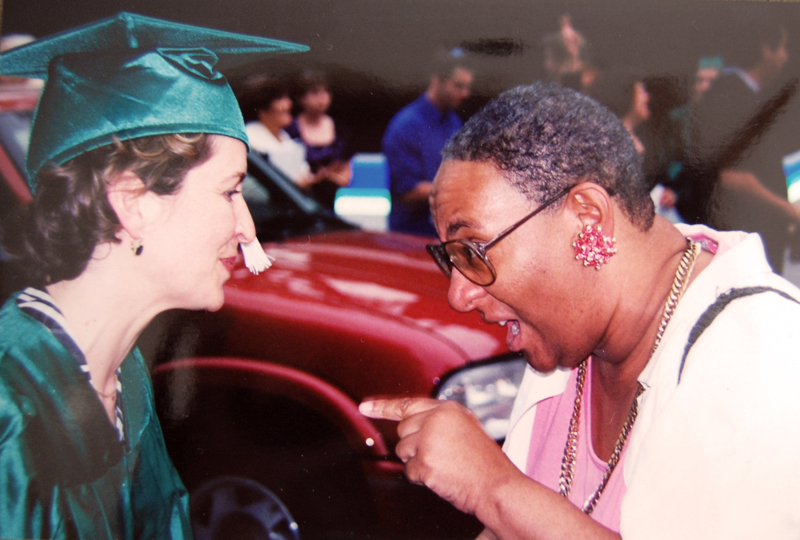
me and my then boss Dr. Pam at my college graduation in 2001*

*Note about Dr. Pam:
There is probably no one who affected me finishing my BA in English more than Dr. Pam, who was my boss for seven years and gave me release time from work to take classes. If I remember right, in this shot she was telling me, "Ruth, YOU made this happen, young lady . . . " after I thanked and thanked her for making it possible. Dr. Pam is dyslexic and was told by her high school counselor that she would never do more than clean toilets. One day Pam saw a black woman walking down the street in PhD robes and decided that was what she wanted, and she did it, having to revise her dissertation 22 times, writing it as a single mom with a toddler bouncing on the bed, all the while battling dyslexia. Now she works with TRIO programs to help at-risk, low income, first generation and academically-middle-of-the-road kids set their sights on college.

-
-
Contas Premium

Poem: Summer labor

-
-

Summer labor

I walked to the house
from the laundry line, the heat
already steamrolling fringes of color out
of the air at nine in the morning.

I was wearing the frumpy
loose dress I fell in love with on the
mannequin but which seemed to olden
on me the first time I wore it.

There I was, shuffling
past the pitiable lavender bed
clutched by weeds and grass,
with here and there pincushion heads

of powdery purple trying
to be charming, reaching out to me,
as if I were the woman
to free them into their full sun

potential. Had they been words
to be weeded into poems, I’d have sat
with them in the latitude of the morning,
yanking away grasses of the outer

world, spreading apart their leggy stems, reaching
in for heads, coaxing them into the bright air
to breathe their wild and dusty breath,
fighting for their very life from within.


-
-

Contas Premium

Poem: Ars Poetica

 -
-


Ars Poetica


A poem makes the impossible
possible.

The poet becomes
a flying proboscis

extracting nectar
from material and

immaterial things.
Then comes the metamorphosis

of the honey. Or
a fly in the attic

descends onto a dusty old book,
which is really the poet,

and the fly’s nomadic feet feel
at home

on the mellow skin of her pages,
as light and moveable

as glyphs and black letters.
Or three minds

become three blackbirds
of a silhouetted tree

transposing notes
into black flames

breathed onto the musical score
of a telephone line.

We know what becomes
of what is written,

the little curled tongues floating
down

on the current of creaking
and arid

centuries:
They are firebirds

whose truth-wings
burn, dissolving into us

in ash, and then one day
right here in the wet ink

from our pollen-laden pen
get reconstituted

into the dewy surprise
of a just-born flyer.


-
-
Contas Premium

National Poetry Month: Prose Poem

-
-
It's National Poetry Month, and suddenly my well has run dry. When I had no particular excuse for writing and posting poems, they popped out, the way babies do sometimes. But just as soon as I tried writing a poem for April 1, the first day of this month devoted to verse, I went into labor of the sort I experienced with my first child: many, many hours of pain and hand wringing and nothing happening.

In fact, not only did the labor last long with little consequence (I finally got a dose of Pitocin after ten hours of labor with dilation to just two out of ten, and that helped speed things up: she was born three hours later), but she was incredibly late. My due date was April 2; she arrived April 30. That would be like the whole of poetry month devoted to expecting her immanent arrival, daily.

She finally did arrive, though I thought she'd never come out. She just took a little more tinkering and tweaking than we expected. And what a masterpiece! Some of my best work yet. This month we celebrate a golden milestone: Lesley turns 30 on the 30th.

This year for National Poetry Month I would like to present poetic forms. I want to try new forms I haven't before, like a cinquain, sestina, triolet, etheree and a rondel. I may write in forms I've already tried, like villanelle, sonnet, tanka and haiku. Besides attempting my own, I'll also post examples by other poets.

Today's form: prose poem. Prose poems are prose pieces that aren't broken into verse lines, but still include other poetic traits, such as metaphor, figures of speech, lyricism, and heightened emotion. One way of writing a prose poem is a letter, which I'm using. It's followed by a sweet prose poem by Amy Lowell.

Here's my prose poem to the baby I waited and waited for in our little house in Pasadena, California, thirty years ago.

To My Unborn Child

Dear Baby ~

I was thinking of you so I thought I’d write.

How are things? I’d love to hear from you.

Your room is ready.

I filled two brown grocery bags with avocados from the trees and the ground out front. I only picked the ones that were heavy and ripe, like my breasts. Dad took them to work to give away.

Did I mention your room is ready? I straightened the picture above the crib last week. I’ll teach you how to do that. See your grandpa taught me. He did it constantly. He couldn’t go through a room without straightening a picture. It’s OK if you don’t get it right at first. You just have to practice. After a while you’ll be straightening things for everybody like Grandpa.

Madeleine, our beagle, keeps misbehaving. When we let her outside, she keeps digging under the fence and getting out. One of these days she’s going to get hit by a car. We should probably tie her up. What a pain. I hate giving her a spanking. I just really have no idea how to train her.

Well, I miss you. Wish you were here.

I love you,
Mommy

She came, and then we had to learn everything;
but the loving came oh so naturally

The baby who finally arrived


And another prose poem:
Bath
by Amy Lowell
The day is fresh-washed and fair, and there is a smell of tulips and narcissus in the air.
     The sunshine pours in at the bath-room window and bores through the water in the bath-tub in lathes and planes of greenish-white. It cleaves the water into flaws like a jewel, and cracks it to bright light. 
     Little spots of sunshine lie on the surface of the water and dance, dance, and their reflections wobble deliciously over the ceiling; a stir of my finger sets them whirring, reeling. I move a foot and the planes of light in the water jar. I lie back and laugh, and let the green-white water, the sun-flawed beryl water, flow over me. The day is almost too bright to bear, the green water covers me from the too bright day. I will lie here awhile and play with the water and the sun spots. The sky is blue and high. A crow flaps by the window, and there is a whiff of tulips and narcissus in the air.

1874-1925
-
-
Contas Premium

Disaster, and why we write

-
-


When the economy tanked two and a half years ago, the magnitude of it didn’t hit me for a couple of weeks, until the Chair of my English department gathered us for the first faculty meeting of fall term. He told us the university had changed forever. Not just our university. He meant that The University as an entity had changed and might never be the same again. He proceeded to describe how the bottom had fallen out of our graduate program, how state funds that had already thinned dramatically, would shrink even more. Some graduate programs across the country would disappear. The question of how to prevent that happening to our own program sat in the room like a cannon ball. For most academic departments, the graduate research program is the driving reason for existence, which is true of ours.

The air was knocked out of me for a couple of days. I couldn’t recall when my outlook on life had ever shifted as dramatically as I felt it at that moment. I continued to advise undergraduate students, but as fear took hold of me, I felt little enthusiasm for the future state of their education. Some students had to drop out of school mid-term as parents lost jobs and their own personal funds disappeared.

After numbly getting through a couple of days advising students, my conversations with them began to shift. I could hear the words coming out of my mouth: “You must write through this.” Like light through the Venetian blinds of my 100-year-old ten-foot office window, something hopeful striped the room as the prospect of writing stories about the suffering and loss that lay ahead of us began to dawn. No matter how dire things would get, we could turn it into a thing of beauty by writing essays, short stories, poems, or screenplays. Even pain can be beautiful.

When cataclysmic events happen in the world, I don’t know how to be. In his "Love Song" Rilke wrote that he would “gladly lodge” his soul “with lost objects in the dark, / in some far still place / that does not tremble when you tremble.” I would gladly protect my soul like that too, but how is it possible to live isolated from tragedy when it happens?

When the earth trembled itself ten inches off its axis, water swept over the lip of Japan’s coast, and the nuclear power plant exploded in Sendai, Inge and I were at the lake cottage on a two-day writing retreat, discussing among other things, the question: Why do we write?

Over the hours some answers came:

  • to remember
  • to think
  • to feel
  • to claim an experience as my own
  • to meditate and connect with my soul

Ray Bradbury said that you must stay drunk on writing so reality cannot destroy you.

Catherine Drinker Bowen said Writing, I think, is not apart from living. Writing is a kind of double living. The writer experiences everything twice. Once in reality and once in that mirror which waits always before or behind.

John K. Hutchens said, A writer and nothing else: a man alone in a room with the English language, trying to get human feelings right.

Truman Capote said, To me, the greatest pleasure of writing is not what it's about, but the inner music the words make. 


The second stanza of Rilke’s "Love Song":

. . . all that touches us, you and me,
plays us together, like the bow of a violin
that from two strings draws forth one voice.
On what instrument are we strung?
What musician is playing us?
Oh sweet song.

Why do I write? To find the points of light in my experience. When we write, those points of light are notes of inner music our words make. When layered with voices of other writers and artists across the terrain of the world, it becomes a fugue, a galaxy of points of light. Have a listen to Robert Tiso play Bach's Toccato and Fugue in D minor on his glass harp. The four-voice fugue written for organ, played on this remarkable "instrument", is but one individual's expression of his own light, and of Bach's. Can you also hear layers of other voices streaming in their light?


-
-
Contas Premium

Little One

-
-


Little One


my own thoughted crumb,
what will you be?

seated, windowed, bound and papered
here
like me?

or full-sailed, wind-carried, faraway and
wild
like the constant, bumping sea?

light in my window, ink
on my page, you are mine,
but remember

as I say this
I set you free


~ Ruth M.


Listen to a podcast of this poem here.

I was going to leave it there, this post. But I just read something by Robert Frost that echoes this small poem of mine. "Little One" could be about a poem, or a future grandchild. Which? Who knows, and that is the surprise of it. Which brings me to Frost.

I've had Robert Frost on my mind. The reason? Because this week marks the anniversary of the assassination of John F. Kennedy (November 22, 1963), an event I always think of as Thanksgiving approaches. I often associate JFK with the image of 86-year-old Robert Frost in black and white at the JFK inaugural lectern January 20, 1961 (I was four), that bitterly cold day when he couldn't read the words of the poem he'd hand written for the inauguration, so instead he recited another from memory. (Read both the dedication poem he intended to read, but couldn't because of poor eyesight, and the poem he actually recited that cold day, "The Gift Outright," here.)

In 1939, Frost wrote an essay about writing poems titled The Figure a Poem Makes. I hadn't read it before today, after finishing my small poem, above. I agree completely with his claim, that a poem must reveal itself, that you can't know at the outset of writing what it will become. You can read the entire essay The Figure a Poem Makes here. Below I will quote passages that resonated for me today:

quotes from The Figure a Poem Makes, by Robert Frost
~ If it is a wild tune, it is a poem. Our problem then is, as modern abstractionists, to have the wildness pure; to be wild with nothing to be wild about. 
~ It begins in delight and ends in wisdom. The figure is the same as for love. No one can really hold that the ecstasy should be static and stand still in one place. It begins in delight, it inclines to the impulse, it assumes direction with the first line laid down, it runs a course of lucky events, and ends in a clarification of life-not necessarily a great clarification, such as sects and cults are founded on, but in a momentary stay against confusion. It has denouement. It has an outcome that though unforeseen was predestined from the first image of the original mood-and indeed from the very mood. It is but a trick poem and no poem at all if the best of it was thought of first and saved for the last. It finds its own name as it goes and discovers the best waiting for it in some final phrase at once wise and sad-the happy-sad blend of the drinking song.
~ No tears in the writer, no tears in the reader. No surprise for the writer, no surprise for the reader. 
~ The line will have the more charm for not being mechanically straight. We enjoy the straight crookedness of a good walking stick. Modern instruments of precision are being used to make things crooked as if by eye and hand in the old days.
~ I tell how there may be a better wildness of logic than of inconsequence. But the logic is backward, in retrospect, after the act. It must be more felt than seen ahead like prophecy. It must be a revelation, or a series of revelations, as much for the poet as for the reader. 
~ Scholars and artists thrown together are often annoyed at the puzzle of where they differ. Both work from knowledge; but I suspect they differ most importantly in the way their knowledge is come by. Scholars get theirs with conscientious thoroughness along projected lines of logic; poets theirs cavalierly and as it happens in and out of books. 
~ For myself the originality need be no more than the freshness of a poem run in the way I have described: from delight to wisdom. The figure is the same as for love. Like a piece of ice on a hot stove the poem must ride on its own melting. A poem may be worked over once it is in being, but may not be worried into being. Its most precious quality will remain its having run itself and carried away the poet with it. Read it a hundred times: it will forever keep its freshness as a petal keeps its fragrance. It can never lose its sense of a meaning that once unfolded by surprise as it went.

-
Painting: Clouds and Water, by Arthur Dove
-
Contas Premium

a birthday

-
-

"She sat there filled with champagne.
S
he talked about hashish and its effects.
I said, 'I have known such effects without hashish.
I do not need drugs.
I carry all that within myself.'
At this she was a little angry.
She did not realize that I achieved those states
without destroying my mind.
My mind must not die, because I am a writer.
I am the poet who must see."


- Anaïs Nin, talking to June Mansfield,
wife of Henry Miller, in Henry and June

-
-
-
Anaïs Nin was born in Neuilly, France,
February 21, 1903 (died January 14, 1977).
Her diary was her closest friend.

Power to diaries. Power to blogs.
Power to the word, to the poem,
and to a clear mind.
Observe, feel, tell the details.

See in · · · out · · · through · · · across · · · beyond · ·
· · along · · · around · · · within · · · underneath · ·
· · outside · · · past · · · into · · · behind · · · ahead · ·
· · onto · · · toward · · · until · · · upon · · · among · · · at · ·
· · over · · · on top of · · · inside · ·

No one else sees the way you see.


window on
rue des Barres, Paris
May 2006

-

-
Contas Premium

New Yorker magazines

-
-


- -
i was going to lug them all to work

let the students take them
or professors
whoever
from the help yourself book table
because they appear in our mailbox at home
every week
and get stacked
in the hopeful piles
waiting to be read
and this morning i remembered being in high school
i used to go to the library at lunch
take the new yorker off the shelf
just leaf thru
look at the ads and the photos
images
cartoons
read the poems
and that was all
and so this morning
i thought
what if the main value to me is that -
get back to what i did as a child
just the images
and so i opened the new issue
and they just touched me
immediately
those photographs
poems illustrations
paintings drawings
even ads
just like then
it was a revelation
i have to get back to who i am -
you know?
have to keep reminding myself
whenever it was a couple of years ago when i was worried about
how i wasn't writing poems
i was obsessed with taking pictures
and in my mind they were separate
and suddenly
it dawned on me
they need not be separate things
they could connect
and that's when i started beginning with just
some visual
and letting it go inside
inspire
and then i could write from it
we all have to find what it is that excites
it might not be the same as anyone else
and some people it will be ten things
all seemingly unrelated
but in that one person
they are mixed and fused
in such imaginative beauty!
and we just stare
and wonder
how we didn't think of it
oh it just makes me weep
for beauty

sometimes a window opens
and it will be like we just

danced
-
-

-
All photos shot near Holland, Michigan, May 2008
-
-
-
Contas Premium
 
Support : Baixartemplatesnovos.blogspot.com
Copyright © 2012-2014. synch-ro-ni-zing - todos os direitos reservados para

CINEHD- o melhor site de filmes online