Novos Fimes do Cine HD
Showing posts with label memories. Show all posts

A home in winter

-
-

I am not much use with my hands. I have bent them to work in an office on computers. They are weak, sore, pitiful. I hold a needle to a quilt a short while, the fabric and batting gathered and bunched in my left hand, the needle a steel splinter of my once-magic wand arm in my right; then my hands collapse, in pain or icy numbness, in the calico on my lap. The most basic tools have no moneyback guarantee.

But once, after the supremacy of Sunday morning church and dinner, these hands of mine built a home. I was five. I had three construction assistants in the yard between the house and the church — ages nine, eleven and thirteen; male; also inexperienced builders. It had snowed; the snow was deep. Then it snowed some more. It was January, the snows piled like ancient stone-dust cities of the Holy Land pilgrimage our parents showed us in slides. Then it rained on our cotton and wool hooded snow suits and on the snow; the rain froze. The black metal clasps of my red rubber galoshes froze shut. If we were very delicate, we could walk atop the crusted snow. With straight-edge machete fingertips, from the large age thirteen size to the small five, we punched out big rectangular snow bricks. Deep, deep I still feel the way of precision, my fingertips in wool mittens slicing snow stones from the whole quarry yard for layering in the masonry of igloos. No one taught us this. When the walls were an inch higher than the thirteen-year-old, my brothers placed the plywood ceiling and finished the exterior with a roof of ice-and-snow slate. We packed white mortar in each gap; smoothed with pearl-iced mitten-index fingers: a ten by ten closet or a small bedroom where the four of us could lie side by side hidden in mystery in the expanse between our father's parsonage and the church. We slept quietly in our civilized and insulated imaginations. We could live there, and survive. So warm; so home. So temporary.
-
-
Contas Premium

"Freedom from Want": Thanksgiving and grandmothers

-
-

What I want is not the turkey on the platter, which seems too big for the spot where Grandma is placing it. And how is she carrying it anyway? My weak wrists would never make it, and the turkey would crash onto the floor. I’d let Grandpa carry it and smile sweetly, basking in the oohs and ahs.

What I want is Grandma herself. And Grandpa. How kind and cuddly they look.

The song associated with Thanksgiving is “Over the River and Through the Woods” which continues with “. . . to Grandmother’s house we go.” I never did such a thing. The only time I went to a grandparent’s house was at the time of Grandma Olive’s death and funeral, in Bayonne, New Jersey, when I was four. I played with toy cars in the steep driveway of my grandmother’s home on the bay. That’s what I remember.

When childhood friends said their grandma died, I thought, big deal. I had no heart pocket for such a relationship.

Grandpa Reuben is the only grandparent I remember, and he was not my mom’s biological dad. He was Grandma Olive’s second husband, who happened to be the cousin of her first, my mom’s dad Sidney. Olive didn’t have to change her last name when she married Reuben. I met Grandpa Reuben twice and was in love with him, the way a girl is in love with her grandpa. He was posh in suits but intensely kind.

Is there a word for being a grandchild orphan?

It is an odd and empty feeling not to have met my grandparents. But it is even odder now to contemplate that my grandparents did not meet all of their grandchildren. Dad’s dad was 70 when he was born; he fought in the Civil War in 1865; he died when Dad was 9. Dad’s mom died in the ‘50s before I was born, the last of eight kids. Mom’s biological dad Sidney was divorced from Grandma Olive and far away when we kids came along. Grandma Olive died when I was four; maybe she held me, I don’t remember. Then there was Grandpa Reuben, a fine substitute, but once on his jostling knees and once after his stroke in a wheelchair is it for memories.

Now, I’m going to be a grandma. When I first found out our daughter was pregnant, I thought I would need advice for my new role, since I had no grandparent memories to speak of. But guess what, there seems to be a heart pocket (think cargo pants) for this relationship after all. Strangely enough, while I’m loving my unborn grandson, it's almost like I'm sitting on my own lap, feeling loved.


Note about the painting: "Freedom from Want" was one of four "propaganda" posters by Norman Rockwell inspired by Theodore Roosevelt's speech to Congress January 6, 1941, urging the country to enter World War II. Read more here.
-
-
Contas Premium

Poem: A mother's breasts

-
-


A mother's breasts


My body in the tub, candlelit,
doughy breasts shining, and
because of the baby to come
from my daughter’s body,
in this dream-light of a crone
everything is mother and baby
again, and my breasts cairns
to the memory of my children,
my daughter first, who swam to me
with her thrashing arms, and landed
a starfish hand on one white beach dune,
locked her shell-bud-mouth onto the biscuit
nipple, the soft pebble of her nose
pressed into shelter, the nipple
her doorknob into the hut—
to survive, to awaken, to trust,
to learn before the intolerable comes
with this quivering tongue, this pause
of eyes, this mouth petalled
into smile, the blue milk pooled
in the upturned keyholes at her mouth’s
curls, that this is the beginning
of life. To be kneaded
by the cupped tongue,
her eyes closed now. To be enough.
To be the bread of life.


-
-
Contas Premium

Poem: Meditations in the stitches of a baby quilt

-
-


Meditations in the stitches of a baby quilt


“Pins and needles” tingle
in my fingers
while I push
a tiny needle
through calico
in a quilt for my
unborn grandson.

Years on computer keys
and the bands over nerves
in my wrists
tightened
like a swaddling blanket
too snug: carpal tunnel. However,

my forearms are mighty,
said the chiropractor.
Like the pen.

But not my hands. Knitters fly,
their needles flapping wool sleeves
like the startled wings of pigeons.
I can’t fly that way.

The baby who will squirm
in this quilt will be startled
and cry. Right here in this quilt,
and it will likely be me
who will one day alarm him
with inadvertent
painful surprise
to us both
and I, too, will cry.

This baby will understand
much. He will surprise me
with the utterly
new and completely ordinary
all his own.

My aching hands will pick
him up, worrying
that I could drop him
in a terrifying
moment of weakness. Causing
pain

like when my son
two days old felt the poke
of a needle into his heel
in a bilirubin test
poor jaundiced boy, intentionally
bled for the good of the whole.
I had to escape
to the soft hall
to muffle his cry through the door

like feeling the needle poke
through these cotton layers to find
my left middle finger
on the other side!

Nice name for a boy, bilirubin: Billy Reuben.
Grandpa Reuben. O happy bouncing
knees of old time me. I did not understand
the pain of losing his gabardine lap
in one stroke. Sad, shiny wheel chair.
Downturned moustache.

I’ll wheel him around, this one
before he can walk. Happy
prospect: You will walk.

I have one life to give you.

And you will run it through
in the meadow like
this tiny needle through calico —
     goldenrod, Timothy grass, thistle.


-
-
Contas Premium

The forbidden "promised land"

-
-

Our street might as well have been the River Jordan.

In my small town growing up our church anchored one corner, and another church the corner opposite, both large, dominant brick structures. Nothing about this arrangement seemed strange to me since it was all I knew.

Our house was the parsonage for the Baptist church, with a porch the size of a ship’s stateroom. When rainstorms battered the neighborhood and filled the air with the scent of wet dust and worms, preventing us from riding bikes, swirling hula hoops or roller skating, we sat on the porch furniture inherited from Grandma Olive and happily witnessed the deluge. We felt the spray on our skin as if we were skimming the surface of the Atlantic from the deck of a vessel cutting through the waves.

Rain flooded the street’s gutters between our house and church and the house and church across the street: the Methodist church and parsonage. Occasionally true to our Baptist belief that immersion is better than sprinkling, and that our feet needed washing, we jumped in and splashed in the rushing water.

But never did we venture into the Methodist church. I played Combat with the neighborhood kids all around its periphery, hiding in the alcoves, which were perfectly suited for our play as American soldiers against German Nazis. This was a couple of decades after the end of WWII, but we had a TV show that all of us loved called “Combat” with Vic Morrow as Sgt. Saunders and Rick Jason as Lt. Hanley. In my memory these soldiers are calm and peaceful purveyors of the gospel of goodness and light.

Besides being the setting for the enemy we searched and shot to peaces in combat play, the Methodist church was where they conducted dances in the basement. Now dancing was forbidden in our Baptist circles as sinful (in spite of scriptures about David dancing before the Lord). After football games I stood in the high school gym under the sparkling ball and watched my friends dance. I never went to the junior-senior prom, though my football player boyfriend asked me. I didn’t even consider consulting my parents, though I longed to go. We must be separate, holy.

Surely the God of the Methodists was more understanding and fun-loving than the God of the Baptists. Dances in a church basement must be safe, wholesome and bright, not tawdry like the close body-pressing in dark, smoky jazz clubs of my mother’s pre-Christian past. There must be a world where dancing (and card playing and saxophones and sex) was a natural and delicious response to the human urge to move, to feel the body’s presence in the air, like the fragrance a rose emits naturally, with no effort, and without any particular end. I had no way to understand the possible harmony of God and dance.

After my parents died my sister and I crossed the Atlantic for two weeks in Paris in 1997. One night we wound down a stair into a subterranean jazz club near the Luxembourg, drank gin and tonics, and listened to an American singer croon standards with a soft jazz ensemble. We were adults now with no parents to protect us from unholy endeavors. Among the tables and chairs with barely enough room for bodies there was no room for a dance floor, but I assure you, we were dancing, in paradise. God was everywhere.


-
-
Contas Premium

Music lessons for Rumi's birthday

-
-

Trade your cleverness for abandonment. 
~ Rumi

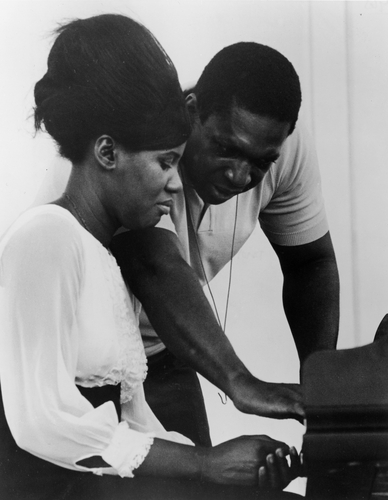
Frederick Leighton’s painting of a music lesson (see note below), perhaps between mother and daughter, and the photograph below of John Coltrane giving piano tips to his wife Alice, offer a pretty, demure picture of music lessons. I am here to tell you that taking piano lessons from my mother was, at times, aggravating. She was so lovely, metaphorically like Leighton's silken mother above. But me, I had no diligence, where she had nothing but. I didn’t care enough about the piano, and I did not like to be told when I was doing something wrong, like when I didn't strike the keys with my fingertips as if they were the hammers on the strings inside the piano.

(Doesn't the porch these two are sitting on resemble a piano keyboard?)

I do care about poetry, with a passion. Because of this, diligence doesn’t feel like diligence. Discipline? Discipline is what you need for doing what you don’t want to do, or want to do but can't seem to find the time, or enough skill for. I am a lethargic procrastinator for nearly everything but writing. (As you witness, in part.)

This week to celebrate Jalalu'ddin Rumi’s 804th birthday (September 30) I’ve been swilling Rumi wine. (Normally I sip slowly.) There's a drunk donkey kicking down fences with all these words turning into wine. I wrote the two poems posted this week after guzzling his words. I don’t want to just imitate Rumi’s poems. I want to bust down mind fences, let the heart kick her way out of the pen of language, while putting my soul out there like fly paper.


Alice and John Coltrane

Rumi's way:
Today, like every other day, we wake up empty
and frightened. Don't open the door to the study
and begin reading. Take down a musical instrument.
Let the beauty we love be what we do.
There are hundreds of ways to kneel and kiss the ground.

translated by John Moyne and Coleman Barks

Poetry should be heard. Listen to Coleman Barks read these lines for a couple of minutes, with musical accompaniment, introduced by Garrison Keillor. I can hardly separate Rumi from Barks' voice, in translation, and sonorous recitation. In this recording, you can feel, there are no fences.


Jalāl ad-Dīn Muḥammad Rūmī
30 September 1207 – 17 December 1273


"Poems are rough notations for the music we are."


Notes:

Image of Rumi on an old book in the Mevlâna museum;
Konya, Turkey; Rumi's body was buried in Konya, but
his spirit lives here, eight centuries later.

Frederic Leighton's "The Music Lesson" at the top is in
the Guildhall Art Gallery of the City of London Corporation,
is oil on canvas, 104cm x 101cm, painted 1877. If the scene
seems to be well suited for a post about Persian Rumi, who
lived most of his life in Konya, Turkey, maybe it's because
it is one of the paintings inspired by Leighton's visit to the
Middle East. The Leighton House Museum in London
interprets the painting thus:

An older woman helps a girl to play a guitar, possibly of Syrian origin. Leighton developed a deep interest in Eastern art and architecture after his first trip to Algeria in 1857, and here we can see him introducing this into his art. The two figures are surrounded by and dressed in souvenirs from Damascus. The architectural setting for the painting shares an affinity with George Aitchinson's contemporary designs for the Arab Hall at Leighton House, although it has also been linked with the sixteenth century mosque of Suleiman Pasha at Damascus.

You can see more paintings inspired by the Middle East by Leighton here.


-
-
Contas Premium

Our lady, and the onions of Chartres

-
-


Our Lady, and the onions of Chartres


Her mismatched spires grow like flamboyant Gothic stalks of wheat and corn out of the fecund plain of Beauce. In medieval days the bounty from these fields was stacked on the cathedral steps, which served as the town bazaar. On the south porch, onions, potatoes and turnips were sold from baskets and wagons under three arches where Jamb’s saints and martyrs in stone supervised. For centuries pilgrims have crawled to Mary’s treasured dress inside—the Sancta Camisia— the sepia’d muslin garment the virgin mother wore over her labor-convulsing body when her boy was born, frail now as onion skin, behind glass and guarded by seraphim. Where has she gone, that woman? I want to feel her warm belly through the dress, the baby kicking. I want to hear her croon to him when his little paw jerks in the air and she nudges her nipple into his trembling mouth.

I am standing under the red and blue pools of brilliant clerestory windows beholding how the brown and buff stone of the labyrinth floor curves and hooks. In the stunning Notre Dame de la Belle Verrière (our lady of the beautiful window) Mary wears a dress of lapis lazuli (the pigment patrons bought for painters more valuable than gold, to give her honor). She is impossibly high, with censers swinging over her crown. The straight, plain wooden chairs have been removed from the floor this one day in a month, so I can walk the labyrinth, slowly. I invite her spirit to rest upon me. It is the year of epiphany, the zenith of my soul’s quest, yet as a result of my measured steps no flames fall from the windows or maternal roots of mystical spirituality curl around my pilgrim feet. The virgin does not bare her glassy breast and offer sacred blue milk. The womb of the church is empty, dark, silent.

We go out and cross the cold street into a cozy brasserie for rustic onion soup, the tables close and crowded under centuries of beams. I excuse myself to find the toilet up a winding stair and half-way up come to a room with its door ajar and window open. Light from the late afternoon sun reflects off the stone building across the street, pouring in on nothing but sacks and sacks of onions wall to wall and piled, spilling upon each other like stones in a quarry, like the fallen stones of Jerusalem. I stare what seems a good while at the nimbuses of holiness surrounding each little onion head and their burlap wraps. How sleepily alive they seem. I go up to the toilet and come back down, pausing one last time at the onion nap room. Back at the table the soup has arrived. I stir the hot salty broth, twirling the white rings, playing like a dervish in a schoolyard with my spoon. I consume, and am consumed by, the labyrinth of the onion.

Listen to Hans Christian play a cello improvisation, from his album
Sancta Camisia, recorded in Chartres Cathedral:


 -

Photos: Notre Dame de la Belle Verrière and labyrinth from wiki commons; Sancta Camisia Metis Linens; onion photo mine. 
-
- 
-
Contas Premium

Poem: In a train

-
-

In a train

Never have I loved so well
the life given me
as when I was rocked
by the four o’clock train
from Chicago to Lansing in 1968,
the lap and arms of iron and steel
holding me, window-framed,
a vibrating twelve-year-old witness
to the dusky backside balconies
of yellow brick apartments
with Hancock’s black tower fading behind,
and I, eating the cool green grapes
my married sister packed, cold
fried chicken, a red and white
paper napkin tucked in a brown bag,
lumbering slowly past city windows
reflecting Magikist neon, where red-trim-
aproned women, the same
high-heeled secretaries I’d seen
on Michigan Avenue, were now fingering
the radio knob for jazz or polka while my train
lullabyed me home toward the small town
of my dull, window-gazing life,
but for a few minutes more, still here,
alone, humming along in the city.


Poetry should be heard.

Posted for the dVerse train poem challenge. This is my first time participating in this really terrific poetry community called dVerse Poets Pub hosted today by Claudia Schoenfeld of jaywalking the moon.


Paintings by Edward Hopper: "Approaching the City" and "Woman on a Train"

-
-
Contas Premium

Polka Dots

-
-

When I was an adolescent in my mother’s kitchen, eating ambrosia salad and pork steaks with gravy made from canned mushroom soup, I was surrounded by the latest pop design. We had just moved back to my hometown after living one year in a depressed town up north. I was about to start sixth grade, and my twelfth (or eleventh?) birthday was imminent. When Twiggy cut her hair short, my sister cut mine like hers.

We moved into the house across the street from where I had spent all my years before the move. The house was my dream house: big, old, oak trimmed, and where I’d played with my childhood friend Jimmie. But the kitchen was a disaster of rusted out white cabinets someone had decided were a good idea when they were shiny and new, the same time they slapped white aluminum siding on the outside. So my dad had the kitchen completely gutted and refurbished with wood cabinets and a pretty wood kitchen table for us who were left at home: Mom and Dad, my brother and me, and an array of foreign students mostly from Thailand.

I remember drawing mushrooms between meals at that kitchen table (along with Snoopy flying his bullet-dotted doghouse Sopwith Camel in battle against the evil Red Baron). Some of the mushrooms had polka dots, which I copied from orange, yellow and olive green placemats, napkins, canisters and glasses Mom had bought for the kitchen. I thought they were cute. I thought they were cartoon imaginings. I didn’t know until walking the farm eight years ago where our own magic mushrooms sprouted, that polka dot mushrooms are real. So yeah, you can assume correctly that I wasn’t ingesting anything psychedelic in the 1960s and 70s. I don't plan to grind these into powder any time soon, but sometimes I wonder what it would be like, after reading stuff like this at wiki:
Spiritual and well being

In 2006, the United States government funded a randomized and double-blinded study by Johns Hopkins University, which studied the spiritual effects of psilocybin in particular. That is, they did not use mushrooms specifically (in fact, each individual mushroom piece can vary wildly in psilocybin and psilocin content). The study involved 36 college-educated adults (average age of 46) who had never tried psilocybin nor had a history of drug use, and who had religious or spiritual interests. The participants were closely observed for eight-hour intervals in a laboratory while under the influence of psilocybin mushrooms.

One-third of the participants reported that the experience was the single most spiritually significant moment of their lives and more than two-thirds reported it was among the top five most spiritually significant experiences. Two months after the study, 79% of the participants reported increased well-being or satisfaction; friends, relatives, and associates confirmed this. They also reported anxiety and depression symptoms to be decreased or completely gone.

Despite highly controlled conditions to minimize adverse effects, 22% of subjects (8 of 36) had notable experiences of fear, some with paranoia. The authors, however, reported that all these instances were "readily managed with reassurance."

There are many psilocybin mushrooms on our walking path, 
more this year than ever. 
Maybe the heat and extra rain are good for them.

-
-
Contas Premium

Of shared taxis and shared language

-
-
These are shared taxis, called "dolmuş" in Istanbul; photo from the late 1980s;
"dolmuş" (pronounced dolmush) is related to the word "dolma" — stuffed pepper, 
grape leaves, etc., because these shared taxis get pretty packed with passengers;
they may not look like much, but even Orhan Pamuk rides in these around Istanbul.

I’m one of those people you can tell who I’m talking to on the phone by how I’m talking. I had a boss who was a boisterous, theatrical woman everyone adored. She laughed a lot and spoke with all the drama of the theater, in which she had leading roles for decades in our community. She entertained every time she opened her mouth. When I was on the phone with her the one time she called me at home, I got off and Don said,

“That was Pam, wasn’t it.”

“How’d you know?”

And then I reviewed myself as Pam for the past five minutes. I had spoken louder and funnier. I even scrunched up my shoulders with enthusiasm and smiled like a performer, as if I were Pam’s mirror self.

I don’t know why I do this. I think I want people to be comfortable, to feel good about themselves. I want them to think I like them so much I’m going to talk like them. I wouldn’t want to talk like me — boring, and heavens I wouldn’t want them to talk like me. I’d rather speak their “language.”

I think this trait is helpful for learning foreign languages actually. When you want to sound just like the person you’re talking to, you have a good chance of at least being intelligible.

When we lived in Istanbul I abhorred standing out as a foreigner. But nothing I could do would disguise the fact. Women in the dolmuş (shared taxi) would look me up and down to see if I had a manicure, how my hair was coiffed, where did I buy my clothes? They knew I was different. And when I opened my mouth and asked the driver in Turkish to stop at the next convenient spot, I was still me, an American in Istanbul, but I could speak their language, at least a bit, and I think they liked that I wanted to be like them. At the end of the day Don would massage the pads between my cheekbones and my nose, which were sore from speaking umlauts. We don’t have those in English. Those muscles screamed, “no pain, no gain.”

The truth is, at the moment I am reading Anne Lamott’s hilarious and helpful book about writing, Bird by Bird, and while she’s talking, I want to write like her. This undoes my theory about wanting the other person to be comfortable. She and I are not having a conversation!


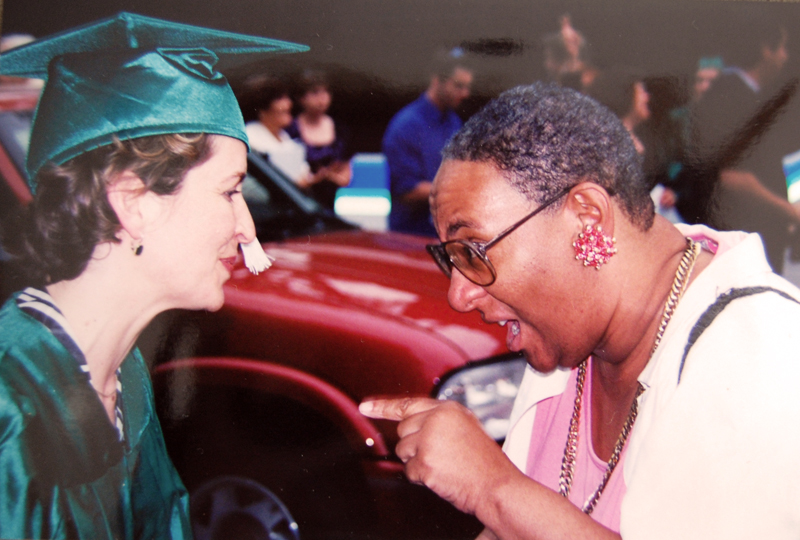
me and my then boss Dr. Pam at my college graduation in 2001*

*Note about Dr. Pam:
There is probably no one who affected me finishing my BA in English more than Dr. Pam, who was my boss for seven years and gave me release time from work to take classes. If I remember right, in this shot she was telling me, "Ruth, YOU made this happen, young lady . . . " after I thanked and thanked her for making it possible. Dr. Pam is dyslexic and was told by her high school counselor that she would never do more than clean toilets. One day Pam saw a black woman walking down the street in PhD robes and decided that was what she wanted, and she did it, having to revise her dissertation 22 times, writing it as a single mom with a toddler bouncing on the bed, all the while battling dyslexia. Now she works with TRIO programs to help at-risk, low income, first generation and academically-middle-of-the-road kids set their sights on college.

-
-
Contas Premium

Nouvelle 55: Nelson's Mandala

-
-
Nelson's mandala "synch-ro-ni-zing"


It never once occurred to me to write a Nouvelle 55 for my 55th birthday. But it did to my brother Nelson who wrote this one for my birthday post today. It is based on this complex and radiant mandala he designed for me in April. When he created it he meditated on the name of my blog, and flights of imagination caught him. I see me at the center. I see the overlapping worlds that touch me. I see crosses . . . perhaps the religion of my past. I see XOXO - the symbols of hugs and kisses which commenters and I use for one another. I see memories, stories, all that has made me who I am. I see the worlds of others around the country and world whose lives have come into mine through blogging. I see vibrancy and life, and most of all color.

Nelson is the oldest of eight kids, I'm the youngest. We didn't bump into each other much at home, since he went off to college before I began kindergarten. He did have a part in naming me. He was sweet on a certain girl, so when Dad asked what they should name me if I was a girl, Nelson said her name, "How about Ruth Anne?"

It wasn't until 1995, the year I turned 40 (the age of my parents when I was born) that our friendship began. When Dad died of cancer six weeks after his diagnosis, Nelson and I were given the task of designing the funeral program for him. The family had to take special care arranging the funeral of a minister who had conducted countless funerals in our little town. While Nelson and I sat with our heads together at the dining table over the typewriter designing the printed program for the service, gradually, and unrelated to our task, out trickled traces of our own stories, revealing similar feelings about growing up in our home. It hadn't always been easy.

Since then, we've grown to be close friends. We talk about the mysteries of the soul, and we're both deeply optimistic about that. "Whether that comes from nature or nurture, I cannot say. Part of being optimistic is keeping one's head pointed toward the sun, one's feet moving forward." Do you know which Nelson said that?

The haiku-esque stanzas of Nelson's poem are like layered stairs of time, bearing our separate-yet-interconnected steps toward spiritual freedom.

These gifts live and move.

Nouvelle 55: Eight Twenty-two


An age ago
Sophia undraped Ruth,
baby number eight.

   Soon number one
   teased out smiles and, later,
   steps from her stances.

      Then he hid in ivied halls;
      when he emerged
      she dropped petals for his bride.

         That couple drove
         into the sunrise
         and Ruthie blossomed.

            Presently
            she soars under stars,
            inspiring him onward and upward.


            Mandala and Poem © Nelson Hart, 2011


Nelson's Note: Ruth describes Nouvelle 55 as a flash fiction or poem in 55 words based upon a work of art. Nelson describes mandala as a symbol of the relationship between the larger world and our inner world; the image accepts life's tension and ambivalence. Carl Jung believed them to arise out of “the unconscious self." For information on mandalas in the Indian subcontinent, see this.

Ruth’s note: Sophia is a feminine aspect of God in the Gnostic tradition. Some say She fell from grace and created the material world, still expressing the light of God. She’s the deep mystery of wisdom (and the wisdom of mystery?). Lately when I pray, I pray to her. I don’t think Nelson knew that when he wrote his poem.


Us 8 kids in 1961 (?)
bookended by Ruthie and Nelson, 
with Ginnie (Boots) 3rd from right;
I loved my matching dress and sweater set,
and velvet shoes

Nelson and Peg's wedding in 1964; I was junior bridesmaid;
our brother Bennett who passed away in 1996 stands next to Nelson;
and our Dad is next to Bennett

Dad married Nelson and Peg in his Baptist church


 my college graduation in 2001 when I was 44,
with Ginnie (Boots) and Nelson,
a sister and brother of the soul as well as the blood


Nelson and me at our great-niece Katy's wedding in May 2011
-
-
Contas Premium

Poem: Departures

-
-


I am on vacation (stay-cation) and am 'supposed' to be working on my book this morning, a self publishing project that I hope to have ready in the fall for anyone interested. Well, I came across this poem in that partial volume, written in 1994, and I thought I'd post it. I am the youngest of eight children. This is about my next older sibling, four years my senior. He doesn't read my blog, but even if he did, I'm not sure he'd find anything in this poem that is untrue or unfair. He was my best buddy growing up. He tried to teach me to laugh at myself when I struck out at neighborhood baseball. He didn't succeed, but I love him for trying.

Departures

He arrived home like a Fenian
in his long-haired sheep coat,
dirty from bus sides, the smell of English
cigarettes a celebration in his hair,
maroon patent platforms cracked
from two lavish weeks on London sidewalks,
fulvous Lennon wire-rims the keystone,
his mark of triumph.

At 18,
he had pocketed his tuition money and cast
the coins over his shoulder into the Thames.

I noticed him camber slightly
as they stepped from the station wagon,
then straighten to the same height as Dad,
the first time my brother ever appeared
a stranger in our town, combating the gravel
of the driveway, so unlike Dad, even calumnious
in his gait, the jingle of foreign currency
audible above the restraint of our welcome.

It was then I knew he had entered a mezzanine
decade or century or maybe an island
where he began to linger
away from us, although 25 years later
he still lives in the same town.
He approached my mother and me on the porch
and, looking me in the eye,
departed across the channel, oars cocked.


Listen to a podcast of this poem here.

Photo still of London in 1970 from the movie "Follow Me" found here.


-
-
Contas Premium

Poem: In the heat

-
-
no, it's not raining here, this is a memory

In the heat

       I remember
the smother of hot nights,
the dark shiftless touch
of maple leaves palmed against the screen
of my second storey window, the street
light outshining the fingernail moon,

      the whole damp town
a small comfort, clapboard houses
porched and facelit, parked cars
hulking shadows sleeping along
to the church, like everyone
but me

               and falling back onto moist
sheets where I imagined hovering
like a cloud, lit from within
by lightning’s quick but
far-fingering promise,
unafraid of distant thunder,
believing he spoke of rain.


Contas Premium

Poem: Church

-
-

I haven't said much here about my journey away from religion. I'd rather not get into it much on the blog, as it's a conversation best done in person, where the back and forth of body language, facial expressions and words are fuller and quicker. But for whatever reason, today I feel the urge to share a poem I wrote in 1995 at the nadir of my journey away from church. Of course by posting it, I am opening a window for conversation, and I'm OK with that, albeit somewhat tentatively. (I find it interesting how rules about not embarking in conversation on topics like religion and politics seem to have slipped aside to some degree in our blogs.) Maybe time will tell if I am courageous, or merely foolish, to post this.

It's important that you know that I hold nothing against church going in general. I know that there are many good reasons for it, including spiritual bliss, which I've experienced. But I like you knowing something of my own lifelong process of looking for spirituality beneath religion. This is a quest I have felt since my earliest memories, even when my own father preached sermons from a Baptist pulpit. My father and mother were some of the most beautiful Christians I have known, with deep felt and earnest beliefs, often taking them in directions starkly contradicting the convictions of people in their own parish. I admire them for this strength, sincerity and zeal. That I was wounded somewhat in the unfolding of their lives is perhaps ultimately more about me than them. I understand also that some of the very symbols that cause me distress, are deeply and joyfully meaningful to others. I hope my poem doesn't hurt or offend anyone, as that is the last thing I want.

Lest you worry when reading the poem that there was any abuse toward me personally or from my parents toward anyone, there was none. While the poem is very personal in a spiritual sense of woundedness, it is more general in the literal.

Anyway, here is one expression of my spiritual journey. I wonder what it will mean, to you. While I love some churches and cathedrals — sitting in them, wandering in them, looking at icons, smelling burning candles, feeling the cool quiet when it is hot and boisterous outside, praying, listening to silence or to music — Church — for me — is another thing altogether.

I welcome your responses, to the poem, or to my opening remarks.

Church

I saw a red window.

Through it the sun in swords.
When light attacks
the skin of pews,
dissolves the frames of fifty strong
sets of arms
and wrought iron lights puncture
and nail supplications
along ceiling beams,

then I know that there are secrets
that wait like wine in cups,
undergarments stained,
wads of bandages under the altar,
some plotting of ambushes
in the marbled veins of windows,
boxes of medals and strategies hidden
in baptistry dust,
the old anticipation of hymns
lined up in battalions,
of the coming,
the coming of a great army,
a mighty platoon dragging all the prohibitions
like sediment, bottles, broken machinery,
parachutes, collapsed
benevolences.

I shoulder this window,
jagged, perforating my skin,
a thorny cross,
a house with wounded furnishings,
a drape of walls hanging
like rags from a carcass,
a make-shift hospital vacated
after the troops have lost
their legs, their arms.

It is only a window,
a sanctuary,
a sifter of days.

1995


-
-
Contas Premium

Memory: Seduction

-
I was already convinced this was the sky I wanted to sleep under, having met him that autumn on the mountain, walking back from the library to the house where my roommates were studying. My eyes had been down, my Clarks scrambling the gravel of the drive. I had been thinking about Hopi Indians who lived in the valley, and the paper I was writing. We do that, attach pen to paper after reading, sure that we know. That’s when he, the sky, pulled my gaze up like a hand and he was a Hopi dancer wearing indigo who’d just tossed his white feathers over his shoulder. He stomped his foot and said, Look: The sky was covered with a cloud of stardust.

Weeks later grounds keeper Bob dropped me off in a wilderness forest in the dark indigo of night miles away from our small campus. That term I was the only student taking the professors up on the offer of extra credit for a solo campout. With a flashlight Bob helped me find a tree, and in a couple of minutes I heard his truck drive away. I mummified in a sleeping bag under a low pine bow. I shivered with fright and human loneliness. I listened to sounds I knew nothing of. How far I was from being a daughter of the earth, lying there on top of the ground.

The night passed slowly. I never once heard the Hopi dancer stomp his foot. In truth, I hid from him under the arm of the Ponderosa pine.

In the morning light, I saw where I had slept. A forest red with pine needles, and fifty feet away, a lookout to the valley, which I hadn’t seen in the darkness. I pulled on my sweatshirt, dug into my pack for a jar of instant coffee, bottle of water, tin coffee pot, mug, and matches. I picked up sticks and walked to the edge of the valley. I built a fire in the dirt.

Before me, across the valley was Mt. Shasta, and what do you know, I saw where the Hopi dancer had tossed his white feathers, and I thought, where is he now. Asleep. Naked. Me forgotten.


Creative Commons photo of Mt. Shasta shared by renedrivers
-
-
Contas Premium

Birth mandala, baby poem, and a wee announcement

-
I wrote a poem for my friend, the Renaissance woman Dutchbaby, at her request for the occasion of a baby shower for a friend. Dutchbaby introduced me to the idea of birth mandalas, which take Carl Jung's concept of mandalas representing the Self, to the next level: an image for a mother to focus her imagination on the emerging identity of her baby. That's one of Jung's mandalas at the right, which I happened upon after writing the poem, with its image of paisley.

Dutchbaby colored a mandala, below (from online mandala coloring pages), in PhotoShop for her expecting friend, who has Swedish heritage. From it I feel my own connection with Sweden through Grandma Olive. The blue and yellow remind me of tole painting on a pitcher or a barn's peak, or in Carl Larsson's kitchen. Dutchbaby paired my poem with her mandala as a gift to the mom-to-be Saturday. (Bless this baby, oh universe.)


Dutchbaby did not know when she requested the poem that we have our own baby on the way. I am going to be a gramma! And so I offer this poem not only to a friend's friend, but also for my daughter Lesley, and the little poppy seed growing inside her to the great size of a kidney bean at this moment, with webbed feet, a bulging head, and joints in her/his knees. Imagine.

Don and I are over the moon, and no amount of exclamatory punctuation is enough for what I feel, so I used just the one, but picture exclam-infinity. (Bless this baby, oh universe.) How about this photo of them with my nephew's baby, Evangeline? (Bless Eva, too.)


The multi-bonus is that Lesley & Brian are moving to Michigan where he begins a teaching job in the fall (exclam-infinity). We will be close by when baby enters the world (due in January), no need for booking flights at just the right time to NYC. Just hop in the car and drive an hour and a half.

Our son Peter (right, with his sister on her 30th birthday this year) just moved to L.A. to join his band Lord Huron (all the band members are from Michigan). Such is life, the child who lived close moves far away, and the one who lived far away moves close. But we are incredibly excited for Peter and feel, well . . . expectant about this change for him.

Dutchbaby's mandala and my poem are below.

A note about koans (in the poem title): When Dutchbaby told me that the expectant mom said the baby was "sitting like Buddha" in her belly, I decided to shape the poem in koan-like questions. (The image of a sitting Buddha also made me think of paisley.) A koan is a question a Zen sage asks a pupil that does not have an answer from the reasoning mind. A famous koan is: What is the sound of one hand clapping? "The master is not looking for a specific answer but for evidence that the disciple has grasped the state of mind expressed by the kōan itself." More on koans here. Samples of koans at The Gateless Gate. If you listen carefully to the podcast of the poem, you can hear the birds that chirp incessantly outside my office window. Does a bird's song answer the heart's questions?


Koan-like Questions of a Mother to her Unborn Child


Is there something quieter than sleep?
      My whispers circle you like jasmine vine, the way
      my arms want to, when my palm will cup your head,
      my thumb in the shallow petal of your temple.
      Terrace.

Where is the pocket in the nightshirt of early morning?
      You didn’t notice just now that I turned over in bed, rolling
      first onto my right side, then onto my left.
      Leaves everywhere on blue-white cotton.

What shape are you?
      In my teardrop body you sleep, sucking your thumb —
      puzzle piece in the circle of your mouth.
      Paisley baby, paisley thumb,
      paisley me, paisley breast. Lace.

What is grace?
      I pull myself up, like a camel, into a sitting position,
      lean left, push off, grunt, rise, stand, and low into the sway
      of this me, your cradle, creaking at my hips.
      Caravanserai.

Do you remember it, that hymn from the old church
through the window as we slowly climbed the stair?
      Holding the bedpost, carved like an altar,
      my eyes closed, up from the organ
      in my chest the music — unnamed song
      through the vibrating reed of my watery throat.
      Repeat.
      Stained glass moon. Bosphorus.

Can you see me in the dark?
      My hand rests on the olive of your shoulder,
      or is that a heel? Hush, keep sleeping, don’t worry
      about positions. You are touching everything
      in any case.
      Mountain magnolia blossom.


Listen to a podcast of this poem here. (You can hear the birds outside my office window if you listen carefully.)

Poem notes: 

Caravanserai: the fortress-like hostelries for sojourners on the Silk Road.

Bosphorus: the body of water between the European and Asian sides of Istanbul; 'bosphorus' means 'throat' in Turkish; Lesley went to school on the European side, crossing the Bosphorus every morning and evening from and to our home on the Asian side.


-
-
Contas Premium

Poem: Endless

-
-
my mom
 
Endless

Fingering the past and its memories
like beads of stone

or bone, like the ivory necklace
of your mother’s you wore,

its carved spheres, milky with river
filigrees, soapy soft,

lotioned almost
like your face skin before bed

oh pressing mine, kissing me good night on my
adolescent pillow

where I was growing, thrumming into myself
drawing pictures of women’s bodies

the way I wanted mine to be
under

forbidden bone, outlawed tusk
engraved for a beautiful woman

to wear upon her neck
hanging down on her bosom

circling, rotating, revolving
in the endless orbit of a life


Listen to a podcast of this poem here.
-
-
Contas Premium

Saturday Nights in the Minister's House

-
-
Before my time, my father was an itinerant preacher, driving his old car through the Blue Ridge mountains of Virginia to four parishes, preaching sermons and ministering to the rural poor. They needed saving, and he had a heart for them. Maybe this is why he kept walking even long after he left Virginia for Michigan, where I was born. He was a walker, a bicycle rider, a car driver, a grocery store cart pusher. Get out the way of the good reverend.

Saturday nights, alone in the upstairs hall he paced in shirt and tie through a tunnel of ancient books with his shoes on, never in stocking feet or barefoot, on the velvet leaves of the Persian runner, rehearsing his Sunday sermon. Striding rhythmically by the books aligned at the edge of every shelf, his feet rang the steps from one end of the hall where his oak desk filled the bay window to the other end at the screen-doored balcony, the toes of his pendulum feet dotting each “i” and jotting every tittle of his Biblical speech.

Beneath him, I sat in the living room with the TV, hearing through the ceiling the creaking cadence of his feet. I prayed the walking would carry on, that he wouldn’t come down and see me watching and listening to a program he didn’t approve with a worldly man on the screen: Dean Martin, born forty years before me, the same year as my dad, but destined for a different vocation. In a black tuxedo, white shirt, and bow tie coming undone with one finger, he crooned. He stood on a different kind of platform, with another kind of mic than my father's. He sang me a rock glass lullaby, loving me with eyes half open from within a nimbus of cigarette smoke.

I had a thing for older men who looked different than my red-haired father. I went for men with dark hair and graying temples. If they were olive-skinned and brown-eyed, I was smitten. Even as a teenaged girl riding on airplanes to visit my sister in Chicago, I kept my eye on the middle-aged gentlemen in suits. I was too innocent, and outwardly aloof, to fall prey to the wrong kind of man, but I had fantasies of their attentions. Dean Martin was the model older man of my daydreams — beautiful, charming and funny.

If my dad paused in place in the hallway above me, suddenly silent, my heart would stop. I’d watch with anxiety for him to appear at the French doors. Then the old oak floorboards above me would chirp again and chide: a phrase in the sermon had been wrong. He’d stopped his hallway itinerary, corrected the line or word, and his steps were off again, pacing steadily, my heart commencing its beat.

I wondered what he had rewritten in the pause, and hallowed in cradling breath, what halo of dust was stirred up around his hesitating feet. What would I hear Sunday morning from the pulpit microphone that he had altered, out of some fault that needed forgiving, so that this time his voice would sound something like crooning?


Photo credits:
Top: Rolfe Horn
Bottom: "Candy Cigarette" by Sally Mann
-
-
Contas Premium

Poem: The Great Gray Owl

-
-


It was disappointing Sunday when I was sitting outside in the summery breeze, writing on the laptop, and Don came rushing up to call me back to the pines where he had seen a great gray owl. I went with him, also rushing, then creeping quietly when we got to the pines. We searched high and low in stealth, but he was gone. I have never seen an owl outside a zoo, though I have heard them at the farm. Don looked into eyes just like these. We did find three pellets on the ground, things that Don's third grade students dissected in his classroom last year, and that was thrilling. (Owl pellets are regurgitated; they're not poo. You can read about owl digestion here, it's fascinating.) As the experience worked in my consciousness, other things floated up and into a poem.


The Great Gray Owl

When I was a girl, at night
I stood in the shower
like a shivering field mouse
afraid of yellow eyes
behind the curtain, the man who wasn’t
there
          the man
not from the street, or the window,
but from the shadowed attic,
or the basement, clammy and dark,
the invisible one who came behind
my skittering heels
while I carried a can of beans upstairs. If only
I had the swiveling head of an owl to always
see the predator,
though what good would a swiveling head do
if he is invisible?

There was a great gray owl in the pines
on a summery day in April
when the wind pushed the bamboo
like dainty bending ballerinas in a row,
first this way, their thin arms up, swaying,
then the other way, leaning at the waist.
My husband came running to me, to pull me back
to the woods to see those black and yellow eyes,
staring as my grandfather’s
had from a sepia portrait
at the top of the stairs
when, the youngest, I had to go to bed
before everyone.
          A man
I did not know, a figment, a phantom.
Handsome, dignified, staring, terrifying.
How could I know — That he,
if he had really been there,
not just gray eyes in yellow skin, flat
man on a flat wall, if he had been full and flesh
as he was at last one year visiting from New Jersey,
that he would torment me on his aging,
bouncing wool gabardine knees with foolish mischief,
teasing until I would gasp
between a giggle and a sob. O too soon
when we buried him he was skin and bones, leaving me
to wonder if ever, ever
I would know for certain that a man was really there,
and whether he was benevolent, or cruel.

The owl was not there.
He had flown. On the ground we found
three owl pellets — hair-covered remains of mice, rabbits, moles —
cocooned bits of skull, white ribs, vertabraic knuckles, teeth.
No eyes. Nothing
but gray shrouds of fur.
What the owl could eat, he ate, then gratefully,
even compassionately it seemed,
delivered them up — whole, like small torsos
without need for arms or feet, beautifully
and purposefully wrapped, woven in wool, napped
and cowlicked, tweedy, suited for the earth,
elegantly prepared for burial.


one of the owl pellets we found; owls regurgitate them, they're not poo;
for more on owl digestion (fascinating), read here


Great Gray Owl photo found here.
-
-
Contas Premium
 
Support : Baixartemplatesnovos.blogspot.com
Copyright © 2012-2014. synch-ro-ni-zing - todos os direitos reservados para

CINEHD- o melhor site de filmes online