Novos Fimes do Cine HD

Turkish Mantı, part two

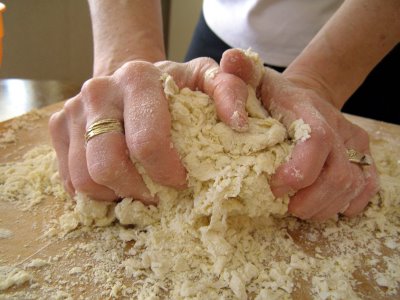
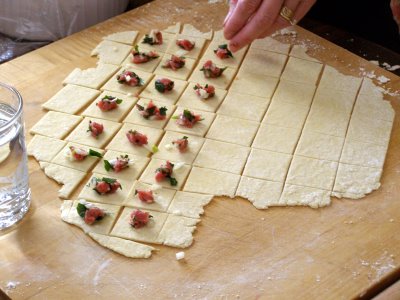
Don, Peter and I worked for about two hours rolling the dough, cutting the dough and filling the dough with meat filling. What a lot of work!

The dough was very stiff, which made the rolling out difficult.

But when we finally got the dough thin enough, it turned out perfectly.


The result was delicious!


But we're thinking the imported dried pasta works pretty well and is a close facsimile. I don't know that we'll ever do it from scratch again!

At least we can say we did it once.

Contas Premium

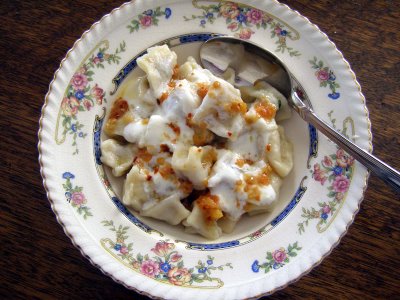
Turkish mantı


Turkish mantı (photo courtesy http://www.istanbulguide.net/istguide/vivre/)

I’m getting ready to try making my favorite food in the world – Turkish mantı – from scratch this weekend. Mantı is pronounced mahn-tih, the “i” like the “i” in “it.” The "i" should not have a dot, but I don't have access to a multi-lingual font in blogger. (Or do you know a secret?) Update: Thank you for the idea, Boots. I had thought of cutting and pasting from a Word doc, and then I forgot to do it! Glad it worked!

You make a simple egg and flour dough, roll it out very thin, cut into 1-inch squares, then fill with a mixture of ground meat (I’ll use half beef, half lamb) and finely chopped parsley and onion, squeezing the dough closed around the filling like a hobo bag. You boil these tortellini-type pasta until nice and soft.

The best part of mantı is what you put on top before eating. On top of the hot pasta stuffed with the meat mixture, you pour a few spoonfuls of plain yogurt mixed with lots of crushed garlic, then atop it all, a good spoonful of melted butter that’s been simmering with crushed tomato and red pepper. Yum!

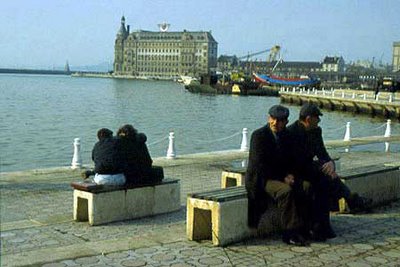
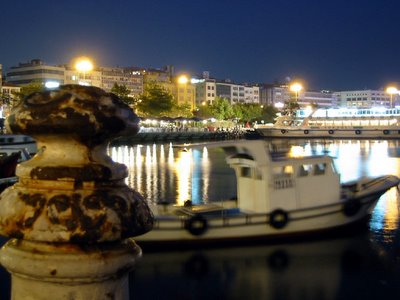
The first time I ate mantı in Kadıköy, Turkey, when we first moved to Istanbul in 1986, I wasn’t too sure about it. The flavors were unlike anything I’d ever tried. But soon it became my favorite dish ever.


Kadıköy, Turkey (photo courtesy http://www.living-turkey.com/living_in_turkey/photos_from_istanbul_Kadikoy.htm)

Kadıköy at night (photo courtesy www-star.stanford.edu/ ~bbaas/trips/)


When I've made it before, I've used frozen ravioli or imported dried mantı. So this will be my first attempt to make it from scratch since first tasting it!

Wish me luck! Maybe tomorrow I'll have my own pics of mantı.

Contas Premium

Thinking in black and white

I’m grateful to live in a day when thinking in black and white terms is becoming less and less acceptable. Issues are complicated. Life is complicated. People recognize it now more than ever. It seems to me that since 9/11 my fellow citizens and I are more aware, more concerned about how and why things happen the way they do.

I don’t know history well, but I want to learn. I’m reading a 1980 book called The End of Order: Versailles 1919, by Charles Mee Jr. about the Treaty after WWI. What a mess that war and that treaty were! They set the tone for the violent 20th century.

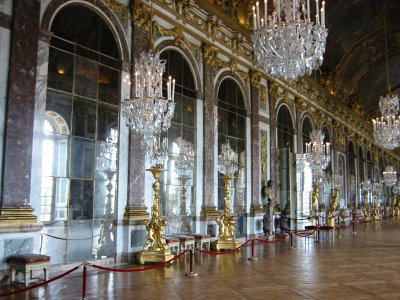
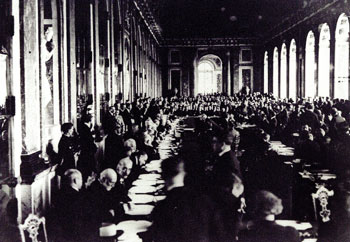
These photographs say a lot.

One is a photo of the Hall of Mirrors at the Versailles palace in color (I visited there as a student back in 1975, but the photo is not mine). Though decadent and gaudy for my taste, it has its own beauty. Prisms bounce around the room from the chandeliers. Rainbows of color.

The second is a black and white shot of the men who signed the Versailles Treaty in 1919 in the same Hall of Mirrors, including our Woodrow Wilson. All men, all black and white. They each had their biases, set ways of looking at the world’s problems, which led to more disaster.

Mee writes:

“By January of 1919, as the delegates gathered in Paris for the Peace Conference, the shallow graves of Verdun were being washed out by the rains; feet stuck out of the ground, and helmets with skulls in them rose up through the mud. In this atmosphere, the diplomats gathered—and, far from restoring order to the world, they took the chaos of the Great War, and, through vengefulness and inadvertence, impotence and design, they sealed it as the permanent condition of our century.”
(original color photo at college.hmco.com/.../ image185_large.html)
Contas Premium

L'atelier

When inside the studio, I'm in a different place and time. A creativity exists in this small space that began with chickens laying eggs here in its henhouse days. The seed of life lingers here.

Now, collected stones and lights are laid here instead of eggs. It's a place for stillness, listening, and feeling the sun through the seven windows.


Contas Premium

Remembering Bennett

Ten years ago today, my brother Bennett died at age 47. He was eight years my senior.

What I recall about him:

  • watching www wrestling on TV
  • watching stock car racing on TV
  • eating 4 mayonnaise sandwiches after school
  • chasing ambulances, literally
  • loving to talk politics
  • wearing a black arm band at his college graduation in 1971 because of Vietnam
  • video taping the family at reunions for hours
  • his amazing photographs (that won many awards), which introduced me to the love of faraway places and travel
  • the beautiful land he bought in the country with plans to build a log home
  • planting 800 trees on that land and watching the deer eat many of them
  • watching a meteor shower together with our kids on his property
  • taking our parents on day trips around the state
  • driving truck or bus for years and years; man, he loved to drive
  • his wry sense of humor

Bennett, I miss you.

Contas Premium

Naming the Unnamable

a field on my drive to work

In “Ludicrous God Talk,” an article in the current issue of Spirituality & Health, Sam Keen writes about naming God.

“The Emperor of the Cosmos is everywhere present but nowhere to be found.”

About trying to name the Unnamable “Maybe it’s like pushing with your tongue against a tooth that is about to come out. The slight pain is slightly pleasurable.”

morning clouds

“No matter how mundane the medium, the experience of the holy is beyond predication or description. We don’t have the linguistic or conceptual needles with which to knit it.”

Contas Premium

Rooftop views

It's beautiful today and in the 40s with sunshine. So I was inspired this morning to click some pics (partly thanks to PG!).

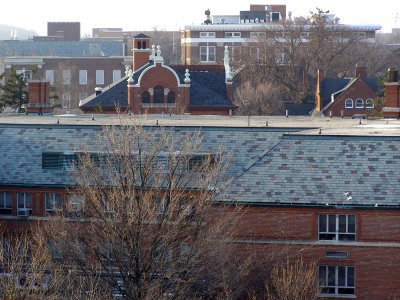
Here are some views of MSU's campus (5,200 acres in all, it's one of the world's largest campuses) taken from the parking ramp across the street.

I love the slate roofs of some of the buildings, such as Berkey Hall in the foreground. Beyond that lies the mission style Old Horticulture building, and beyond that the Agriculture building.


The photograph below shows three buildings from different eras. In the foreground, the red brick and sandstone are Morrill Hall built in 1901, wherein my office in the English department lies. The porta-potty is atop the new parking ramp being constructed on the Grand River Ave side of Morrill.

Beaumont Tower, beyond Morrill on the right, was built in 1928 and its carillon contains 49 bells. The largest bell weighs 5,000 pounds; the smallest weighs 15 pounds. Click here for the MSU fight song! :)

Beyond that you can see the MSU football stadium that was rejuvenated in 2005 with luxury suites, thanks to the Ralph Young Fund.

Looking at these buildings from this height reminds me that sometimes I need a fresh perspective.

Contas Premium
 
Support : Baixartemplatesnovos.blogspot.com
Copyright © 2012-2014. synch-ro-ni-zing - todos os direitos reservados para

CINEHD- o melhor site de filmes online