Novos Fimes do Cine HD

corny garden fun

-
-


If April showers bring May flowers . . .


what do May flowers bring?


Pilgrims.


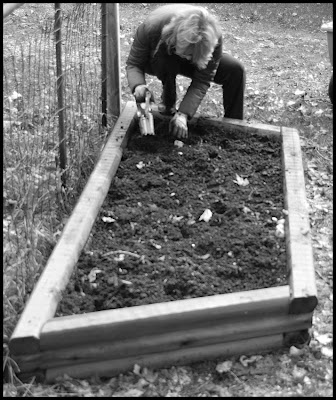
Planting tulip bulbs Saturday I thought about my dad in his quilted plaid wool shirt raking leaves. His wavy rusty hair had gone gray in those later years, but I still see him standing in the russet maple leaves with matching hair blowing up like a flame to the sky.

Dad was a Baptist minister. He crafted words into two sermons every week, fifty weeks a year, one for the formal Sunday morning service and another for the more casual evening service. His words were not flowery, they were just right. He wanted the gospel to speak for itself through him, a simple vessel. His Virginian accent had softened so you could just barely tell he was Southern. My ever-supportive mother said every week, "Carl, that was the best sermon you have ever preached."

But when he was home, he hardly spoke. We - my mother and eight kids - had to guess what he was thinking. Sometimes he would sit at his end of the big dining table, put his fork down and wait while we figured out what he required. Was it the salt? The bread, butter? The peas? At last after we passed him two or three things he would help himself and we would go on with our own plates. I am guessing he thought the other nine of us talked enough and he just didn't want to add anything else to the room.

But both my parents loved words, the English language, witticisms and word plays of any kind. Nothing got my dad to chuckle through his teeth like a word play. He didn't write this verse I found, but it is just the kind of thing he would have memorized and recited with a big goofy smile.


Cabbage always has a heart;
Green beans string along.
You're such a Tomato,
Will you Peas to me belong?
You've been the Apple of my eye,
You know how much I care;
So Lettuce get together,
We'd make a perfect Pear.
Now, something's sure to Turnip,
To prove you can't be Beet;
So, if you Carrot all for me
Let's let our Tulips meet.
Don't Squash my hopes and dreams now,
Bee my Honey, dear;
Or tears will fill Potato's eyes,
While Sweet Corn lends an ear.
I'll Cauliflower shop and say
Your dreams are Parsley mine.
I'll work and share my Celery,
So be my Valentine.

"Let's let our Tulips meet."


Do you know about "spoonerisms"? Take a minute and at least read the first story of Rindercella, her mugly other and two sad bisters and how she eventually slopped her dripper for the prandsom hince to find who tried it on her mugly other and it fidn't dit.
-
-

Contas Premium

What else?

-
-


What Else?

First you're born and
you're alive-
What else?

Over the years
you hear confessions
that you tuck into
your swaddling clothes

Eventually you wear them
like a fleece
of deep forest green
collar up

A cozy suspicion
clothes you
the way night
clothes the moon

And what is that moon
if not a comfort
in the deep blanket
of your life

the stone that might help you
remember
What else?


Contas Premium

a different light

-
-

Sky lover Violet Sky commented on the special warm glow of the morning and evening sun in October in my last post. I agree with her. Sometimes, though, as she no doubt could attest in Toronto, the glow of October's light is rather cool, if that makes sense, and sends you inside for a warmer radiance in a brick fireplace. As another friend says, it's starting to be "candle time."

Inge and I drove an hour and a half to my family's cottage (home of the Wild Things swing) for a writing retreat. It was dark and chilly - except for some brief moments such as this one when Inge was crowned with cool light on a stage of diamonds backed by milky drapes - and when it wasn't raining, light fingers of wind tipped the oak leaves spilling their rain reserves down onto the ferns, moss and tin roof. It was just the right atmosphere for nesting in the couch cushions behind a stack of books and a slow dancing fire.


Conversations with Inge are about stories. Of authors she reads and the very few I read too, such as Orhan Pamuk (click here for my encounter with him). Oh - his beloved İstanbul is also my beloved İstanbul. Or is it? He steps out one way, and I step in another. It is his story, it is my story. Or we talk about her mother's scattered leaves of stories collected and piled in attic letter boxes before Inge and her sister arrived, a world apart. Or Inge's own story, which she wants to write down for her fourteen year old son, with her places, favorite things, her poetry, sketches and photographs. We talk about truth versus fiction. What is the Truth? How does Memory serve? How can I fill in the vast gaps of knowledge about daughter of Swedish immigrants Grandma Olive? I don't remember her at all though she must have held me before her death when I was four. What can I piece together of her from what I have heard from stories told by Mom: taping wallpaper designs around the walls to match patterns as she drew them; sisters Susan, Bootsie and Nancy: falling into the goldfish pool and being terrified of breaking something valuable in the not-too-child-friendly house; and brother Nelson: Saltine cracker & peanut butter sandwiches she made for his snack - each unique and colored by their own separate memories? And what truth of her can I corral from her china, or the "bastard" cabinet she painted, or her sewing box, and the vases she collected?

Just as there is a different light in October, and there is a different light inside, there is also a different light within each of us. This light is more powerful than we are sometimes willing to acknowledge, and it slants this way and that and glows uniquely from each individual. As Eric Maise wrote in one of the weekend's fireplace books (one Inge gave me on some Christmas or birthday), A Writer's Paris, from the chapter "Hemingway Slept Here":

I don't care where Hemingway slept. . . What writers write interests me. . . . If Hemingway is important, it is because what he had to say still touches us. But is it important that on this exact spot, now smack in the middle of a fancy mall, he had onion soup after a night of debauchery? Hardly. The past is no substitute for the present. Love the 1440s, love the 1680s, love the 1920s--love any epoch that touches your soul. But start each day focused on your writing and not on your literary maps.

Bring along the stories of others that have touched you. You can't help it. But write your story, as only you can.


Contas Premium

simple sudden October

-
-

Impulsively, I have to show you the morning, driving out of the farm and across the county on that old meridian road. It stops me sometimes.


Verlyn Klinkenborg wrote yesterday -

A day isn’t just a standard measure,
all the same size so each fits on a calendar page.
A day is a period of light, an astronomical event.


I will respond to your comments in the last post soon.
-
-
Contas Premium

Where the wild things are swinging

-
-


If I had to choose only one book to save from our children's shelves when they grew up, it would be Maurice Sendak's Where the Wild Things Are. (No doubt a whole lot of other people feel the same.) Sendak wrote and illustrated the 48 page, ten sentence book in 1963, and I discovered it the next decade during bookstore "squats" in the children's section when I was in college. Maybe I wished I had written it and drawn those illustrations. A few years ago I did copy one of his pictures onto the new seat Don sawed for our 60-year-old swingset my siblings and I grew up with, which now sits on the hill behind our family cottage. This was the first time that old swing seat had been replaced. I used to fly so high on it that I wondered what would happen if I looped all the way up and over the top of the A frame. What I imagined didn't happen, thank goodness, but Sendak's vision did, as I copied and painted his swinging characters right onto the new wooden seat. I even bought a copy of the book to leave in the cottage's red reading room so kids would be sure to have the book handy for a read after swinging.


So you'd think I would have been ecstatic at the movie theater recently when I saw a trailer for Spike Jonze's upcoming feature movie version of Sendak's book. But my immediate reaction was horror. NO! You can't make this book into a movie! I closed my eyes to shut out the images and saw only those from the book in my memory.

In the book you have ten glorious run-on sentences (for example: "Almost over a year and in and out of weeks and through a day and into the night of my own room where he found his supper waiting for him and it was still hot."). You have a boy's dream after he has been sent to bed without his supper, illustrated in some of the most evocative images ever. You have a nightmare transformed into a love story, the mysterious dilemmas of parenting with mercy and grace, and conversely of being a child who has to grow up into a responsible person, but not quite yet. You have delicious and cuddly monsters painted in warm earthy tones. You have cute small Max in a white wolf suit and crown. The way he dishevels that crown when he's sleepy is so charming! As a lover of children's illustrations, I got lost in them. I wanted little text. Making it into a movie would fill in the gaps of imagination in unwanted ways, changing it forever.

It is the dilemma of all books-to-film. How do you take Michael Ondaatje's The English Patient and make it into the film "The English Patient"? In that case, the book is spare and wonderful, and the movie is lush and wonderful. Both succeeded. But often the film is a disappointment after a rich book. Of course the opposite can often be said too.

In a fantastic article Loring sent me by Wendell Berry (he whose beloved poem resides on my sidebar) about our country's warped economics, in which he criticizes the entertainment addiction we're in (The Progressive, Sept. 2009, p. 24), Berry wrote:

If you can read
and have
more imagination than a doorknob,
what need do you have
for a "movie version" of a novel?


To agree with Berry, you could argue that a novel is different from an illustrated children's book. Without illustrations, a novel relies on the reader's vision of each scene and interpretations of characters. If you're a good reader, this terrain can be fertile indeed. If a movie gets made, and if you had any attachment to the book, you wish they would consult with you about the cast, set, direction and costumes! It's your story now after all, for the scenes and characters have evolved into your inventions too. Especially vile is when a film is made of a classic tale, such as "The Scarlet Letter" or "Last of the Mohicans," and the story is changed unrecognizably and unforgivably into a more palatable (sell-able) Hollywood adaptation. Why not just write a new story-script in the period and context?

To argue against my original mortification, a children's illustrated book is different, no matter how sacred, especially if the author was also the illustrator. Apparently Maurice Sendak has been working on a movie version of Where the Wild Things Are since the 1990s, and he pursued Spike Jonze as the one to make it. How do you argue with a book's author, if he had a vision for it as a film? It makes perfect sense that a visual artist would cross over into film. And from the enticing film sets and costumes I've seen so far, I myself can feel the pull. Can he help it that so many of us own this entity called Where the Wild Things Are and might object to his decision? Such controversy in my head over his imagination's expression!

In the video below you can hear Sendak and Jonze describe their collaboration in the movie. As Sendak says, Jonze took the peculiarness of the book and made it into his own Where the Wild Things Are with Jonze peculiarness. The glimpses of the monsters in the misty forest and silhouetted by the crashing sea, and of the fabulous Max, who happens also to be a "Max" in real life, have seduced me. Guess where I'll be October 16? In the presence of a newly inspired and evolved expression of what Maurice Sendak made possible: a wild seat to ride up and up as high as the next visionary could take it.

But please, no movie version of Goodnight Moon. I can live with the sweet animation narrated by Susan Sarandon, but I will not allow my future grandchildren to watch it on TV when I'm around. They must look at the pictures from my lap and hear "Good night comb and good night brush" from my voice box, feeling my heartbeat against their temples. And then I will close the finger-softened pages of the book and tell them for the 100th time how their mother said "Dat Doh" for "Goodnight Moon." Then I will eat them up, I love them so.


Here are my siblings' grandchildren helping me put the new swing on that old swingset.


Contas Premium

pride and joy

-
-

Peter has been home several months between the band's cruise ship gigs, bringing us humor, music, wittiness and creativity. He was his sister's Man of Honor and our man of help for the August wedding here on the farm. This baby o' mine leaves again in a few days for a third and maybe final three month gig. Last week the ship's official videographer Stephen graced the farm with boyish Vancouver sophistication (that's him on the left), and we ate a burger in our local tavern while they caught us up on their just completed documentary road trip to Chicago and Nashville. This will likely be Peter's last extended stay at home, since he hopes to move on to NY or London after the Hawaii tour, and I have the same melancholy I did in 2006 when he moved out after college and I wrote the prose poem below. There is pride and joy watching our daughter and son pursue their lives. And there is longing to remain with them always. Such is life as we accomplish just what we set out to do: help them on their way.


A Son Moves Out

Guitar picks sprout from the necks of multiple guitars lined up like timbers on the family room floor. The limbs of his body stiffen with the weight of a duffle bag and amplifier that seem to want to keep him planted here - oddly, since it's the music that's pulling him away.
A stump on the couch, I look out the door he opens, at willow fronds hooking and tossing their ochre against the snow field like fishing lines. A gust rolls through the house. I hold on to the couch. The fabric pleat flies up horizontally, the arm covers blow off. I dig my toes into the cushions.
Rooted, I stay. Like a twig, he goes.


Here is a 4 1/2-minute video of Bonnie Raitt singing my favorite of one of Peter's heroes, Stevie Ray Vaughan in a terrific version of Vaughan's "Pride and Joy."

Contas Premium

dishes

-
-


With the onset of autumn, I remember that I have china. "The Holidays" are around the corner with all that feasting - the first being Thanksgiving in November when we'll welcome Don's family to the farm. I will be digging into the china cabinet for bowls, cups, plates, pitchers and platters to serve mashed potatoes, gravy, turkey, stuffing, cranberry sauce, candied yams, coffee, and pumpkin pie.

I collected the cups and saucers, above, from different antique shops because I loved the rosebud handles. Once I fell for the first set, it was not easy to find more. This was before eBay.

This egg cup is a good excuse for making soft boiled farm fresh eggs Friday morning after Thursday's Thanksgiving feast. My set of Spode buttercup belonged to Grandma Olive, then my mother, and now to me. When I pull them out, I feel I am touching my women, and their hands are now my hands.

No matter how humble the home of a woman is, she feeds her family on dishes. On special occasions she will spend extra time chopping, mixing, cooking and filling her best ones with feast-worthy delectables. If her mother used those dishes before her, their value goes deeper. And if her mother's mother used them before her, serving food in them is an even greater joy.

Every ladle of food - from the thinnest soup to the heartiest meat - becomes food for the soul as well as the body when family and friends come together and multiply memories and generations through celebration.

My sister Nancy gave me this Irish Belleek butter dish that looks like an Irish cottage. It is so lightweight, it feels like you are holding a seashell. You can tell it is European because it is square, not oblong, for the European shape of packaged butter. I cherish it as a gift from my sister as well as for the link to Ireland where I have fond recollections and connections.


Everyone in the world deserves to eat well, to live well. In photographs of the world's poorest communities, I have seen blue tarp shanties set up with style, neatness and grace. There is an instinct within us humans, in women especially, to nurture the family. This nurturing is for the body, the soul and the heart. When she feels her dishes are beautiful, the food is appealing, and that she is bringing her loved ones together at special times to create new memories and remember old ones, it is worth every chop of an onion, each whisk of butter and flour for a roux, all the stirring of thick batter for cake, all the rolling out of pie dough for custardy pumpkin filling, the kneading of bread dough for yeasty buns, and every heartfelt anvil of stress over the possibility that everything won't get done or taste delicious. There are many men, like Don, who also feel these instincts and spend hours in the kitchen out of a desire to nurture loved ones.

What follow are from a big heavy wonderful book called The Way We Live by Stafford Cliff with hundreds of photographs by Gilles de Chabaneix, showing how people live around the world. I chose some pictures of people preparing food, as well as dishes.


Romania


Bangkok


Sweden


Provence


Sweden

And this final photo is not from the book but was taken by rauf near Jaisalmer, Rajasthan, India. When I saw this at his post in February I was so touched I had to stop and be quiet. This is a mud hut, and the woman of the house designed and built the wall mounted dish rack herself.


Contas Premium
 
Support : Baixartemplatesnovos.blogspot.com
Copyright © 2012-2014. synch-ro-ni-zing - todos os direitos reservados para

CINEHD- o melhor site de filmes online