Novos Fimes do Cine HD

Acorn season

-
-

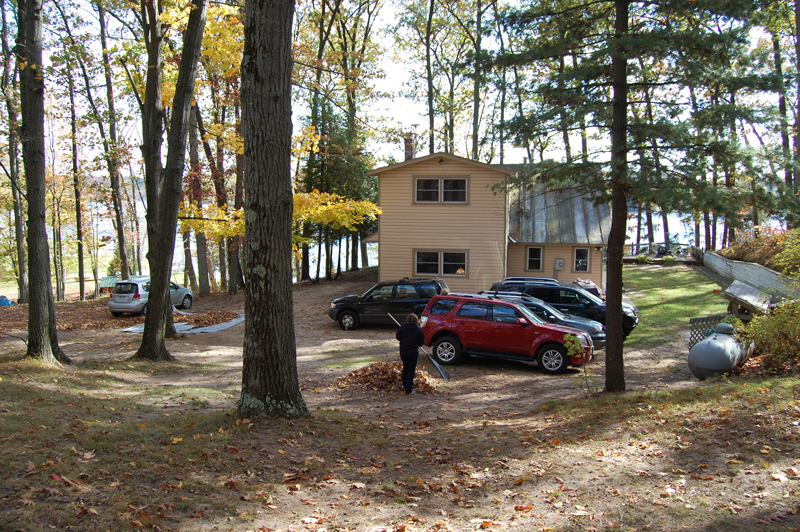
Nineteen of us, including babies, headed to the family cottage for the fall clean-up Saturday. We took out screens on the porch and washed the storm windows before putting them up. We cleaned behind the stove and fridge. We raked leaves. We raked and raked and raked. We piled leaves on tarps and dragged them into the woods.


There's a lot to rake, all the way around, down the hill to the lake, and down the driveway.


Our cottage sits on a hill, the highest point on the lake, except for the state-owned woods next door, which we don't have to rake, thankfully. If you know about feng shui, our cottage has a pretty good feng shui position with its hill at the back and side, and facing water.


This is the view of the place from the lake.


It takes a big investment of energy and funds from our individual selves to maintain this place and keep it in the family, now that Mom and Dad are gone. Sometimes Don and I think of the vacations we could take somewhere every year with our share if we didn't have this place to keep up.

And then we gather with our family at one of the spring or fall work days, or the 4th of July, or New Year's, and we realize again that we have something very special. We have a home where our tribe can go, and keep our love alive.

I wasn't even going to post about the cottage clean-up this year, and then when I viewed my pictures I had to show you the acorn harvest and what I learned.

For hours, the kids picked cleaned up acorns. (Their work was important.) There was a bumper crop this year! I asked Audrey if she thought they could pick them ALL up. She said with complete assurance: Yes. Of course it became a competition between the girls and the boys. But when I asked Audrey if they were going to count them all, and she said, No, I said, well how will you know who wins? That stumped her. She and Lydia stored theirs in the playhouse oven. Eli and Johnny stored theirs in the plastic dock owl. I don't know who won. I don't even know if they know who won. I do know that not all the acorns got picked up, but don't tell them.

The icing on the acorn cake was when Casey (in the next to the last photo, below) decided she was going to make acorn cakes. (You can see the ball of acorn dough in her right hand in that photo; that's a lot of acorns.) I asked her if acorns are edible, she just shrugged her shoulders and smiled big with her gorgeous white teeth just released from their cages (braces). I told her I was not about to sample her acorn cake until I knew they were not poisonous (where was my sick-at-home husband when I needed him?). Someone googled it on their iPhone and we decided we were safe. You know what? Acorn cakes are not bad. She just added flour and water. I could survive with Casey if we were stranded near oak trees.

Of course when I got home and asked the sick [smarty-pants] husband about eating acorns, he coughed and sneezed out a fine lecture on the Native Americans, especially those in California, who made breads and mush with nutritious acorns, soaking them first in water to remove the tannins. They used the tannin water to tan animal hides. Read this beautiful history in our National Archives of the California Indian Acorn Culture. You know what I just remembered? I think Casey's mom has Native American heritage. Casey was not taught this by a relative though. It was in her somewhere, waiting for acorn season when the acorns called.


In the photo above, you can see a number of things: The original structure, on the right, built in the 1920s with its tin roof that is wonderful to fall asleep under in our beds at night when there is a rainfall lullaby (but alarming under acornfall!) and badly needs replacing; at the left, the addition my father built in the 1960s (after my grandpa bought the place for my mom) to accommodate the ten of us, and eventually many, many more; and most importantly for this post, notice the little green sandbox lid at the bottom left behind the woodshed where Casey and Sydney stashed their acorn collection, which ended up in the acorn cake, below. (Oh! Casey and Sydney won!) In the first picture, Gary (visiting from Guatemala, next to Rachel from Brazil), is smelling the acorn dough.


-


-
Contas Premium

Autumn haiku

-
-


how many times you try
to land right
but you forget the wind

    ~

my mother's mind
a leaf in the air
blowing away

    ~

a leaf stem
held by a wet stair
allowing the leaf to watch below
like a turkey vulture

    ~

a floating petal
caught on a spider's shaft
a crane stutters overhead

    ~

caught in his arms
late in life
she said, I do


Have you tried haiku? Though the strict form is 5-7-5, meaning five syllables on the first line, then 7 on the second and 5 on the third (a syllable is on in Japanese) modern haiku is less structured. Haiku in Japanese means "playful verse". The most important elements in haiku traditionally are the kigo, or season word (such as frog, which indicates spring) and the kireji, which is the cutting word. The cutting word, which comes somewhere in the middle, creates the playfulness between the first part and the second, maybe a tension or a revelation. Also, the poem should invoke images, which is what Robert at The Solitary Walker did in his poem "aeolian"-- very imagistic and haiku-esque, as in this couplet: 

     black crows strut on black earth
     tricking the eye

Thank you, Robert, for the inspiration. I was writing haiku in my mind all the way to work after reading that poem. It's nice that your treks inform your inner journey, something I've enjoyed from George at Transit Notes and Lorenzo at The Alchemist's Pillow as well.

Good haiku is not easy, I think. I like going back to the "old" haiku poets for studying their skill at capturing so much in just a few words and sounds, like Basho:


An old silent pond...
A frog jumps into the pond,
splash! Silence again.

~ Basho (1644-1694)

. . . or Soseki:

Over the wintry
forest, winds howl in rage
with no leaves to blow.

~ Soseki (1275-1351)


For more inspiration, a nice site for modern haiku is modernhaiku.org.

Reading or writing haiku is an illuminating way to meditate.


-
-
Contas Premium

Tofu is not as boring as I thought, in fact . . .

-
-
Tofu Steak
. . . it can be pretty amazing.

But "delicious" and "tofu" are not words I ever dreamed of pairing not too long ago. I had enjoyed fried tofu in Pad Thai and other dishes where it was tossed in for good non-animal protein, but I had never even considered eating it as its own course, big and geometric on the plate. That texture, and the blandness. Bleh. Once again, my ignorance of what has been enjoyed for 2,000 years is mind blowing. When ignorance leads to aloofness, or worse, arrogance, it's not good. And, it can prevent you enjoying tremendous offerings. This is how I was about tofu. Then a few months ago, my boss (who lessened my ignorance of Early American Lit eons ago) took me to lunch at Omi, a terrific Japanese restaurant near the university, and since Don and I were on a path to eat less of the beef steak variety, I saw tofu steak on the menu and the description convinced me to try it. After the first bite, I thought I'd die (from enjoyment, not from choking). My boss, Steve, looked incredulous at my enraptured face, and when I offered him a bite, he declined and started off on something about Nathaniel Hawthorne and witches . . .

With tofu steak, the outside of the tofu is delicately crispy, while the inside is creamy. Those textures coupled with the sweet-savory sauce are a winner (you can leave it savory without any sweetness if you prefer, as in the original recipe, below. Also, If you don't like mushrooms, just leave them out.)

Now, whenever Don and I go for sushi and rolls, we also get tofu steak. In fact we love it so much we decided we ought to learn to make it at home. We dug around for a recipe online, and so I want to share the one we picked and tweaked, because it's so simple and yummy, and I want you happy. Making it together takes about 10 minutes prep (mostly chopping) and 10 minutes cooking; Don sautés the tofu, and I make the sauce. Tofu may be bland alone, but it absorbs flavors beautifully, so I'll keep trying new dishes. Maybe you have favorites you'd like to share.

The online recipe is here. Our tweaks in autumn rust. Here is a podcast of me reading the recipe. . .  Just kidding!


Tofu Steak With Japanese Mushroom Sauce (or without mushrooms, if you prefer)

Yield: 4 Servings - We halve the recipe for the two of us, since this doesn't keep well.


Ingredients


4 firm tofu - we use soft tofu, which gets crispy outside and stays creamy inside
1 c fresh shiitake mushroom
1 c fresh enoki mushroom
1 pk regular white mushrooms
- we use whatever mushrooms we have on hand
1/2 green onions
2 cloves garlic
2 tablespoons sake (Japanese rice wine)
- we don't have sake and use Sherry
4 tablespoons soy sauce
2/3 c dashi (Japanese fish stock) - I need to find some of this, but we use about 1/3 c fish sauce mixed with 1/3 c veggie broth
2-3 tablespoons brown sugar, to taste (Whenever we've eaten tofu steak at several sushi places, it has been sweet, though this original recipe does not call for sugar.) 
          2 teaspoons cornstarch
         a few teaspoons cornstarch on a plate.

         1 teaspoon salt


        4 tablespoons vegetable oil


Instructions

1. Place a clean cloth towel in a shallow plate (something like brownie
pan would be good) and put Tofu on it for 30 minutes to drain water. Wipe the surface of Tofu with paper towels and sprinkle some salt (to make the surface of the steak crisp and brown when done.)


2. Cut off the stem of mushrooms and slice them. divide Enoki into small
bunch. Cut green onions in 2 inches long. Finely chop garlic.


3. Dredge Tofu in cornstarch on a plate covering all sides 
and ends with cornstarch. Put 2 Tbsp of vegetable oil in a
 frying pan and fry all sides of Tofu in medium-high heat 
(we slow it down a little and sauté on medium heat),
until Tofu turn golden brown. Put them on serving plates.

We buy packaged soft tofu in water and cut it in half for two people,
halving this recipe. After draining per #1, we cover all surfaces
with cornstarch and sauté all six sides of the oblongs
(what are oblong "cubes" called? Oh, Don says they are rectangular prisms.)


4. Wipe the frying pan with paper towel and add another 2 Tbsp of vegetable oil. Saute garlic and the mushrooms in medium heat quickly. Add Sake, soy sauce and Dashi stock and bring it to boil. Add green onions. We wait and add the green onions at the very end, since we like them better barely cooked. Dissolve cornstarch in 2Tbsp of water and add to the sauce. Stir from the bottom of the pan and pour it over the cooked Tofu. Serve while hot! (4 servings) We cook the sauce in a separate pan while sautéing the tofu.
NOTE: Dashi is the basic soup stock used in most Japanese dishes such as
Miso Soup and Udon. You can get the powdered stock called 'Hondashi' in any Oriental stores. Substitute it with chicken stock or veggie stock if you like. Shiitake and Enoki are very expensive in the U.S., but they are very flavorful. Try not to cook them too long.


Allow me to share one more great tip for preparing tofu for adding to stir fries and soups. Rather than frying (I'm trying to use less oil), you can bake it and get that nice fried texture. I found the instructions here.

BAKED TOFU: Buy one pound of extra-firm tofu and bake it in the oven using this easy method: Heat the oven to 400 degrees Fahrenheit (200 Celsius); cut the tofu into 1/2-inch slabs; marinate it for a few minutes in a couple of tablespoons of soy sauce, a tablespoon of honey, and some minced garlic; then spread the tofu on an oiled baking sheet and bake until crispy on the edges and golden brown (about 25 to 30 minutes).


It contributes greatly towards a man's moral and intellectual health, 
to be brought into habits of companionship with individuals unlike himself, 
who care little for his pursuits, and whose sphere and abilities 
he must go out of himself to appreciate. 

~ Nathaniel Hawthorne


-
-
Contas Premium

My mother tells me it was good

-
-


My mother tells me it was good


Out of the spine of the piano my mother
is calling, and for the first time her voice to me
is jazz. Through my headphones
and a black man’s touch on the keys and strings

I hear her -- the tingles and flashes, rolls, sparks
and hints that used to fill the white church
under the shadow of the cross, telling me
There is more to piano music than "Jesus Saves"

and more to my mother than what I know.
In crystalline notes of his, I recognize her timed pause,
a drop from an icicle melting in the sun
that falls the moment just after you know you want it.

In duet, a saxophone’s smoke rises to the sun,
helping it warm my mother’s piano confessions to me
drop by drop -- those revelations I envisioned, prayers
she breathed in a jazz club before she found God,

suspended, frozen in the veil of her past, yet whispered
through chinks -- in winks and inklings to me
on the black and white hymned keys for the someday, this day,
when I feel their beating hum in the melting icicle of my spine.

~ Ruth M.
Hear a podcast of this poem here.


-
-
Contas Premium

The Bridge

-
-


This is Farwell. I don't know if that's his name there on the motorcycle, but that's the name of the little town whose population doubled when these bikers stopped for breakfast. Three years ago this weekend I was on my way north for a solo weekend away, because it was the 50th anniversary of the construction of one of the longest suspension bridges in the world. The Mackinac Bridge spans the Straits of Mackinac between the lower and upper peninsulas of Michigan. The anniversary was an excuse for my Aveo, my camera and me to run off together and cross that 50-year-old bridge, one year after I'd turned 50 myself. We ladies have to support each other (nyuck nyuck). (Did you know that bridge is feminine in German, but masculine in Spanish?) I left home (southeast of the star on the map at the capitol, Lansing) and a couple hours later drove into Farwell (not too far from Midland on the map), a town where you don't have to stop since there are no traffic lights or stop signs going through town. But I did stop, to check out this caravan of motorcycles. I sat down on a bench across the street from the diner where these bikes were parked, and waited with my camera. After reading Zen and the Art of Motorcycle Maintenance in college, I always wanted to take a cross-country motorcycle trip (I'd love this pre-1916 Cannonball Coast to Coast Vintage Motorcycle race). Maybe this was my chance?


When the bikers came out of the diner, they took their time, chatting about where they'd stop next. The gentleman with the Harley-burly beard in the foreground of the photo at the top of the post sauntered across to his bike parked in front of me on my bench and immediately asked if I'd like to go for a ride? Hmm. Here was my long-awaited opportunity to ride in the open air, hair flying from under a helmet, bugs on my teeth. Route 66, here I come!

I declined, however, with all the courtesy I would give the President of the United States. If I think about it too much, traveling alone as a woman can be a little creepy. So I don't think about it too much. (I admit that once or twice in motels I have gotten pretty weirded out if the Psycho shower scene sneaks past the doorlock in my head.) I have found that if I treat people with respect, they treat me the same way. When I'm in Chicago or NYC, and I'm lost? I'm going to ask a construction worker for directions, even though they sometimes come off as being, well, aggressive, toward women (or has this changed?). Something in me really likes to confront assumptions in myself, and in others about me. I have never experienced anything but the most genteel behavior in these encounters (except a few times from whoever is with me, who thinks I've lost my mind). I have approached the thuggiest looking people (I don't mean construction workers are thuggy-looking), and while they may look surprised at first (aren't we all surprised when a stranger comes up to us?), they are always helpful. Something gets bridged between you. If you've never tried approaching the least likely person on the street for help, try it, it is liberating.

I'm careful and don't put myself in dangerous situations. I get a sense if a person is not the kind I want to approach, maybe it's a sixth sense. I always have a cell phone. I only explore in public places, and always in daylight. But I love to travel, and I love to do it alone sometimes, which Don graciously understands, if for some reason he can't join me. He says he doesn't worry about me, although there is one artistic neighborhood project in Detroit I am eager to explore, and he won't let me go alone, even in the daytime. Being vulnerable, because I'm a woman, can be very frustrating in its limitations.

Perhaps my trust in strangers began on my first day of school in kindergarten, when I lost my way home and was crying on the sidewalk. A strange man in a truck stopped and asked if I wanted a ride. No matter that everyone had told me not to get into vehicles with strangers. I said, Sure. He drove me two blocks home. To this day, I don't know how he recognized me, but I didn't know him.

Have you ever traveled overnight alone, just for fun, not business?


my Aveo parked in front of the motel in St. Ignace, Michigan in October 2007
where I was the only guest for the night;
St. Ignace is the first town over the bridge in the Upper Peninsula

state park beach along Lake Huron

northern Michigan farm

Harbor Springs, Michigan

Five Mile Creek, a one room school

wild turkeys in northern Michigan 
(by "northern Michigan" I mean the northern part of the Lower Peninsula)

Mackinac Bridge, between the lower and upper peninsulas of Michigan
from the upper peninsula in St. Ignace

Mackinac Bridge, from the Upper Peninsula
in its 50th year, 2007

Mackinac Bridge, on my way to morning coffee and breakfast at a diner

rustic boat on a rustic beach

wild beach yarrow
-
The turquoises and blues of the Great Lakes are better in autumn


I am severely disappointed that we did not get up north this summer, and our plans for going this fall have also fallen through. That's why I'm posting three-year-old photos, because of my wanderlust for that magical part of the world just a few hours away.
-
-
Contas Premium

Turkey Vulture

-
-

My leather clogs are soaked with dew and yesterday's rainfall through to my socks, and my backside is damp from the roughhewn rain-sodden bench, which is unsteady on the soft ground of the meadow. Low sun shines on my back and on the path’s thick wet grass that needs mowing. In October, the mower forgets his way through goldenrod that have lost their stars. White and yellow moths have flown away. Bees have no flowers to woo and have disappeared. The fire of sumac is flickering out, flame by flame. Yellow leaves on the tallest poplars around the pond applaud the parade of clouds marching past. Oh look! They have never done that step and roll before. Clap-clap-clap-clap-clap. Some in the meadow are falling asleep, unimpressed, while the chickadees keep fee-beeing and squeaking their high pitchpoints, and tree swallows treet their trits then swallow them in gurgles.

What have I come here for? Where is my place? A tippy bench at the center of things. So like a human. It takes long to quiet, shoulders hunched, hands warming under my thighs. Ah, just relax, kid. You think too much.

I don’t hear him coming, no treets, sqawks or screeches, but a shadow betrays him, like my brother’s thumb-hooked hand silhouette on the projector screen. I’ve seen them for days, since the neighbor bow-shot a deer and gutted him, leaving the entrails for wild animals in the field. I have seen them from the kitchen window, perched in the highest poplar branches like hunters in blinds, patient. But this morning, they are six-foot kites crisscrossing a gentle sky, scouting. Silent as arrows. He, my personal turkey vulture, could be scoping me, in my black crow hooded jacket, still as death. But I do not imagine this is so. Instead, I am certain that he is showing me how to scout, scope and scavenge. Why else does he arc over the pines and back under the sun, like a slow motion boomerang? Why tip and turn just there where the cloud parade ends, showing off the flourish of his wing-tip baton? What possible reason could he have for spreading his wing feathers like a sumac branch directly above me, floating down so close I swear I can feel him tap a message of longing on the wind’s drum? If he does not mean to demonstrate the silent way of seeking sustenance, why are we here?

You can listen to a podcast reading of this piece here.

-
-

Contas Premium

Cézanne: Love the Apples

-
-

Rainer Maria Rilke, letter to Clara Westhoff
Paris Vie, 29, rue Cassette
October 13, 1907 (Sunday)


Today I went to see his pictures again; it’s remarkable what an environment they create. Without looking at a particular one, standing in the middle between the two rooms, one feels their presence drawing together into a colossal reality. As if these colors would heal one of indecision once and for all. The good conscience of these reds, these blues, their simple truthfulness, it educates you; and if you stand beneath them as acceptingly as possible, it’s as if they are doing something for you. You also notice, a little more clearly each time, how necessary it was to go beyond love, too; it’s natural after all, to love each of these things as one makes it: but if one shows this, one makes it less well; one judges it instead of saying it. One ceases to be impartial; and the very best – love – stays outside the work, does not enter it, is left aside, untranslated: that’s how the painting of sentiments came about (which is in no way better than the paintings of things). They’d paint: I love this here; instead of painting: here it is. In which case everyone must see for himself whether or not I loved it. This is not shown at all, and some would even insist that love has nothing to do with it. It’s that thoroughly exhausted in the action of making, there is no residue. It may be that this emptying out of love in anonymous work, which produces such pure things, was never achieved as completely as in the work of this old man; his inner nature, having grown mistrustful and cross, helped him to do it. He certainly would not have shown another human being his love, had he been forced to conceive such a love; but with this disposition, which was completely developed now, thanks to his strangeness and insularity, he turned to nature and knew how to swallow back his love for every apple and put it to rest in the painted apple forever. Can you imagine what that is like, and what it’s like to experience this through him?

I'll get to this letter of Rilke's in a sec.

In my early days of writing, writer and poet (also art historian and critic) Rainer Maria Rilke’s Letters to a Young Poet spoke soft and clear: Go inside yourself. That has stayed with me since those days in the early 1990s, along with William Everson’s Birth of a Poet, and many other writings that focused on a similar theme. Go inside. Go inside the subject, and go inside myself.

The Austro-German Rilke wandered across Europe much of his life, and for the decade from 1902 to 1912 or so, he lived in Paris, working on a book about the sculptor Auguste Rodin, and as his secretary for about a year of that time. Living among the Impressionist artists of the Paris Salon transformed Rilke and his poetry, filling him with a desire to "apprehend the very essence of things," eventually resulting in his "object poems". Besides Rodin, perhaps Paul Cézanne had the biggest impact on Rilke and how he viewed art and the world of artistic expression. It was Cézanne who more than any other painter was a bridge between the Impressionists of the late 19th century and the Cubists of the early 20th.

Rilke was married to sculptor Clara Westhoff (who had studied with Rodin) though they separated in less than a year, and he left her and their daughter Ruth in Worpswede, Germany to live in Paris. While he was there he wrote her letters, enough letters about Cézanne alone to fill a book. The quote that opens this post is in one of the letters. My paraphrase of that paragraph is: When Cézanne painted, he wasn’t saying in his paintings, See how I love the apples; here, love them too. He just . . . loved the apples. That love exists in the paint, in the pulsing colors, in the bold smears and layers laid on by his palette knife, as real as the apples themselves.

Love is attention. What does it take, to spend a life paying attention to apples, arranging them in countless still lifes? He even told his human subjects who sat for paintings: Be an apple.  As writers and artists, are we overly worried about production, recognition and accomplishment? What would happen if we just love the subject we are portraying? Pay attention to it so closely that we are it. How can something pure and vibrant not come of that?

I owe a debt of gratitude to Marie Howe for her recent interview in The Writer’s Chronicle (sorry, the interview is not online; it is in the hard copy May/Summer 2010 issue), which inspired this post and the rumblings of many things inside me. She said profound things about poems, among them: "What mattered to me was not a book of poems but a poem. Each poem. One poem. It was a world. You know what happens when you read a true poem. It sees you, you see it. . . . It's love, really. Recognition and love. . . . To write one poem seems to me worth living for." 

I leave you with a gallery of Cézanne's apples.


Four Apples

Apples and a Glass

Apples on a Sheet

Still Life with Plaster Cupid

Still Life with Compotier

Apples and Biscuits

Apples and Napkins


 Apples and Oranges

 Dish of Apples

Still Life

Still Life with Apples and Pears

Still Life with Apples

Still Life with Apples (2)

Still Life with Apples (3)

Still Life with Apples (4)

Still Life with Apples (5)

Still Life with Soup Tureen

Still Life with Milk Can and Apples

Rilke's letter to Clara found in Art in Theory, 1900-2000, an anthology of changing ideas, Charles Harrison, Paul Wood

All apple paintings found here

There is a beautiful article about Cézanne's impact on art, at the Smithsonian here.
-
-
Contas Premium
 
Support : Baixartemplatesnovos.blogspot.com
Copyright © 2012-2014. synch-ro-ni-zing - todos os direitos reservados para

CINEHD- o melhor site de filmes online